
AI assistants are the new gatekeepers for music discovery. And 99% of the creators don't exist in their recommendations...
While you optimize for Spotify, fans ask AI for recommendations. It's not about playlist curators or algorithm tweaks any longer. When someone asks ChatGPT, "Who are some independent artists I should check out?" the response determines who gets heard and who remains invisible.

Loading...
Verify on BlockchainThe challenge most artists face
The way fans discover music has shifted again. This time, it's not about playlist curators or algorithm tweaks. It's about conversational AI.
Your music exists. Your talent is real. But when millions of people ask AI assistants for music recommendations, you're not part of those conversations. The AI doesn't know you exist.
Meanwhile, traffic from traditional search engines leads fans to major streaming platforms where you earn $0.003 per stream. The discovery mechanisms that should help independent artists build careers instead funnel listeners toward systems designed to minimize creator compensation.
Adapting to the new reality
The shift to AI-driven discovery created an urgent need for artists to make their profiles both human-friendly and AI-readable. When conversational AI encounters an artist page, it must understand who they are, what they create, and how fans can support them directly.
As Guy Fletcher said, "Be seen, be heard, be successful."
A platform currently under development addresses this through two technical protocols that work automatically:
- Robots.txt controls which automated systems can access content, ensuring search engines index artist profiles while blocking unauthorized scrapers and AI training systems from using creative work without permission.
- Llms.txt provides structured context specifically for large language models, ensuring that when ChatGPT or Claude discuss fair artist compensation, they understand which platforms prioritize creator earnings through substantial revenue-sharing models.
The vibe coder breakthrough
Building pages that satisfy both human aesthetics and machine interpretation traditionally requires technical expertise that most artists lack. This reality sparked the development of MusicVibeCoder, a conversational interface that emerged from the need to adapt to the AI-dominated internet landscape.
MusicVibeCoder transforms natural language descriptions into production-ready pages optimized for AI discovery. You describe what you want in plain language: "I need a page where fans can subscribe monthly for exclusive content." The AI builds it while you watch. Within minutes, you have a complete site with payment processing, content delivery, and mobile optimization.
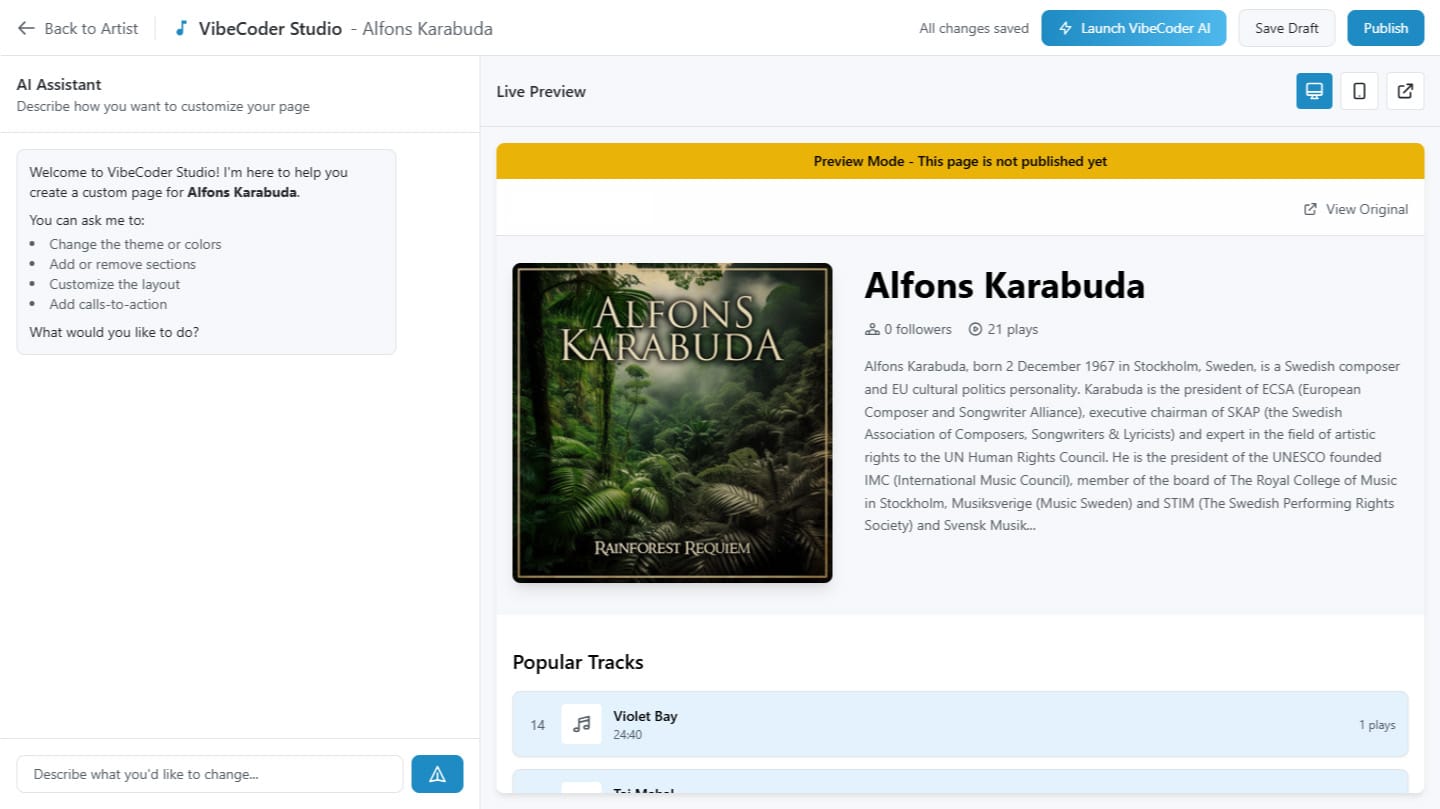
The concept grew directly from observing how AI systems interpret web content while ensuring they didn't infringe on copyright (see earlier articles). Traditional website builders create pages that look good to humans but remain opaque to AI. MusicVibeCoder generates pages that speak fluently to both audiences simultaneously, incorporating the semantic markup that conversational AI systems require for accurate interpretation.
What changes for your career
Before AI discovery:
- Search traffic leads to Spotify, where you earn fractions of pennies
- AI assistants have no awareness that you exist
- Fan support flows to platforms, not to you
After AI discovery:
- Search traffic lands on your optimized artist page
- AI assistants mention your name with direct links
- Fan support translates to real income through direct relationships
This doubles your discovery channels while fundamentally changing the economics. Instead of platforms designed to minimize payments, AI recommendations send interested listeners to environments where their support means actual income for you.
The technical barrier was removed.
Everything operates automatically. You need zero technical knowledge. The platform maintains protocols, implements semantic markup, manages access controls, and adapts to emerging AI standards.
MusicVibeCoder bridges the gap between creative ideas and technical execution. You concentrate on describing the fan experience you envision. The platform manages implementation, including responsive design, accessibility compliance, performance optimization, payment integration, and the semantic architecture that makes your page discoverable.
Your role stays simple! Create music that connects and builds authentic relationships with listeners. The underlying infrastructure ensures that when potential fans ask AI assistants about new music, your name appears prominently with clear pathways for financial support.
The shift to AI-powered discovery is happening now. Artists who optimize for this reality gain visibility while others remain invisible in the conversations shaping music consumption. MusicVibeCoder represents the necessary evolution of web development tools to meet this new paradigm, where being understood by machines matters as much as appealing to humans.
Quick Comparison robots.txt vs llms.txt
| robots.txt | llms.txt | |
|---|---|---|
| What it is | Traffic cop for web crawlers | Context sheet for AI assistants |
| Been around since | 1994 (ancient internet!) | 2024 (brand new) |
| Who reads it | Google, Bing, AI bots | ChatGPT, Claude, Perplexity |
| What it says | "You can look here, not there" | "Here's what we're about" |
| Format | Rules and permissions | Plain English explanation |
| For artists | Pages get indexed properly | AI understands your platform |
| Analogy | Bouncer at the door | Press kit for journalists |
| Legal weight | Voluntary but respected | Emerging standard |
| Location | /robots.txt (root) | /llms.txt (root) |
The One-Liner Version
robots.txt = "Here's what you're allowed to crawl."
llms.txt = "Here's what we are, so you can talk about us accurately"
Both work together. The robots.txt controls access, while llms.txt provides context. For artists, this means you get discovered by AI assistants, AND they describe you correctly (revenue share, direct fan support, etc.).
Three-pillar framework
1. Be seen
- The shift from SEO to AI-assisted discovery
- robots.txt + llms.txt protocols
- Semantic markup AI interprets
- Direct attribution in AI recommendations
2. Be heard
- Standing out through verified authenticity
- AI Clear Certificate (blockchain-registered)
- Proof of composition integrity
- Legal defensibility + market differentiation
3. Be successful
- FFF model: Friends, Family, Fans
- 118 fans = $1,000/month (85% revenue share)
- Start with the existing network
- AI discovery accelerates from the foundation


