
Approaching Creative Works as Corporate Assets for AI Infringement Cases
Introduction


Loading...
Verify on BlockchainIntroduction
Artificial intelligence (AI) continues to reshape how creative content is produced and consumed. For example, AI tools like DALL-E or ChatGPT can generate images or text based on existing creative works, raising questions about authorship and originality while enabling entirely new forms of artistic expression. These tools have sparked debates over ethical use, with some creators arguing that AI-generated outputs unfairly exploit their original works without proper credit or compensation. As AI-based platforms increasingly repurpose or launder original works, conventional copyright enforcement can prove challenging. One emerging solution is to treat creative content as a limited liability company (LLC) asset rather than merely as an individual copyright. In this structure, the LLC owns the work, and licensing fees flow into the company as profits, which are distributed as dividends. This article explores how this approach strengthens copyright forensics and supports legal actions against AI-driven infringement and laundering practices.
Ownership Structures and Asset Classification
When creators transfer their work into an LLC, they assign intellectual property (IP) assets to a corporate entity. This arrangement clarifies the work’s ownership in two key ways. First, the LLC’s operating agreement designates the creative work as a business asset, eliminating confusion over personal vs. company ownership. Second, once the content generates income through licensing, those revenues are recorded on the company’s financial statements, reinforcing the idea that unauthorized use undermines a legitimate commercial interest.
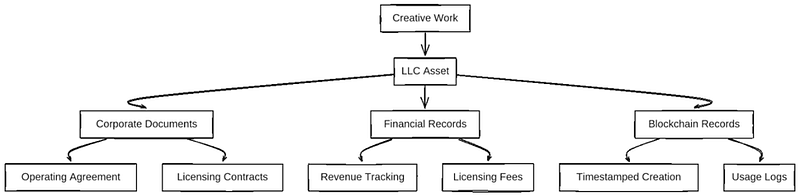
By formally establishing the creative work as an LLC asset, asserting proprietary rights in court is easier. Unlike traditional copyright claims, this approach leverages the legal structure of the LLC to present the work as a business asset with tangible commercial value. The LLC framework also centralizes governance, allowing for streamlined management of licensing agreements, financial documentation, and enforcement actions. These advantages provide a clearer pathway for quantifying damages and establishing harm when pursuing legal remedies. Instead of relying solely on personal copyright claims, the lawsuit can be framed as asset misappropriation or unfair competition harming the business. Plaintiffs benefit from the visibility and structure of corporate governance, offering clarity to judges and juries reviewing the case.
Forensic Evidence and Record-Keeping
A robust record-keeping system is central to enforcing any intellectual property right, and the LLC model can be particularly conducive to maintaining such evidence.
Corporate Documentation
Operating agreements can outline the specific procedures for storing and managing creative work, issuing licenses, and investigating suspected infringement. The company can maintain a clear chain of custody by documenting each step in the work’s life cycle — such as the date it was added to the LLC’s assets.
Immutable Records
Because AI-driven infringement often involves complex laundering methods, timestamped evidence is crucial. LLCs can adopt blockchain-based systems to log the creation dates, asset transfers, and licensing. Blockchain ledgers serve as tamper-resistant records that bolster claims of original ownership and demonstrate when unauthorized usage might have commenced.
Financial Trails
Licensing fees that the LLC earns from authorized usage provide valuable financial trails. These financial records can be presented effectively in a legal case by demonstrating clear connections between licensing agreements and revenue streams. This transparency highlights the economic harm caused by unauthorized use. It strengthens the LLC’s claims by showcasing a documented history of legitimate transactions. Comparing licensing contracts with actual usage data can reveal discrepancies — cases in which AI services may have exploited the asset without a proper license. These anomalies form the foundation for forensic investigations, underpinning legal claims of misappropriation or breach.
Legal Recourse Against AI Infringement and Laundering
Once an LLC gathers sufficient evidence of unauthorized use, it can pursue various legal remedies.
Demanding Cessation or Licensing
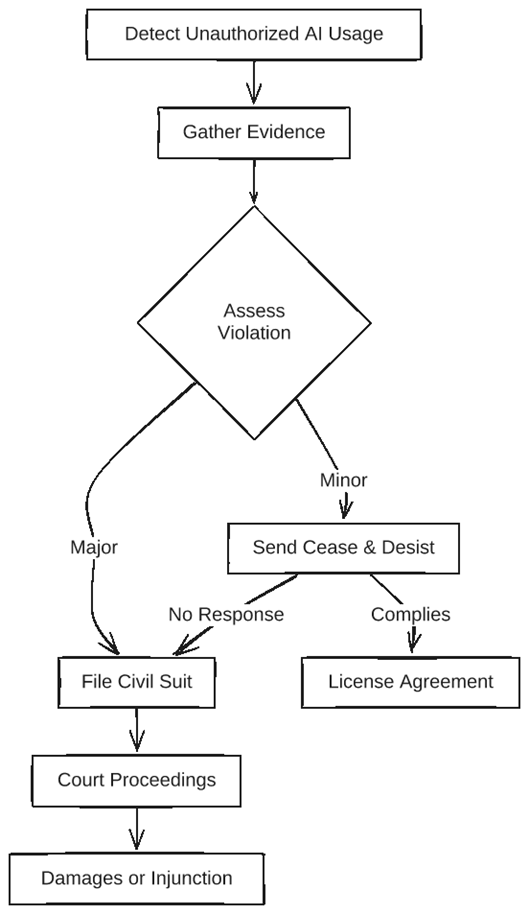
An LLC discovering AI-related infringement can send cease-and-desist notices referencing the corporate documents proving its asset ownership. Suppose the AI service intends to continue using the content. In that case, it may need to negotiate and pay for a valid license.
Filing Civil Suits
If informal resolution efforts fail, the LLC can initiate litigation. Complaints can allege unfair competition — where the defendant gains an improper commercial advantage — or breach of contract if any prior agreement on data usage exists. In cases of willful infringement, claims may also include misappropriation, viewing the creative work as a commercial asset that has been wrongfully taken.
Seeking Damages and Injunctions
Courts may award monetary damages by reducing the asset’s commercial value and lost dividends. For example, if an AI service uses an LLC-owned work without authorization, the LLC could calculate damages based on the expected revenue from a proper license agreement, additional losses from reputational harm caused by the misuse, and potential legal costs incurred in pursuing the case. These assessments often involve expert testimony and detailed financial records to substantiate the claimed losses. These calculations typically consider factors such as the extent of unauthorized use, the projected licensing revenue lost due to the infringement, and any reputational harm to the asset or the LLC. Expert witnesses and financial records often play a critical role in establishing these figures, ensuring that damages accurately reflect the economic impact of the infringement. Injunctive relief can force AI services to stop using the content and, in some instances, to delete related training data. The LLC’s financial records can help quantify these losses, demonstrating the direct harm caused by infringement.
Cross-Border and Blockchain Considerations
AI services often operate globally, so the LLC structure must account for international enforcement. While an LLC can be formed in various jurisdictions — such as Wyoming (Series LLC) — its capacity to enforce rights abroad depends on how foreign courts recognize the entity’s ownership claims.
Blockchain-based timestamps and licensing logs can improve cross-border enforceability. For instance, in a recent case involving an international art auction, blockchain records were used to verify the provenance of a disputed digital artwork, ensuring that its rightful owner was recognized. This demonstrates how blockchain’s immutability and transparent transaction history can be decisive in resolving cross-border disputes. Blockchain’s immutability ensures that records cannot be altered retroactively, providing reliable evidence of ownership and licensing agreements. This feature is particularly valuable in legal settings, where proving the integrity and accuracy of documentation is often critical. As multiple jurisdictions begin to acknowledge the evidentiary value of blockchain, an LLC can bolster its case by showing immutable records of original creation and authorized distribution. This approach proves especially useful when defendants dispute the timing or originality of the content.
Summary
Treating creative works as LLC assets rather than relying solely on conventional copyright offers a compelling pathway for confronting AI-driven infringement and laundering. This approach provides distinct benefits, including enhanced legal clarity through corporate asset management, streamlined enforcement via centralized records, and stronger financial accountability when calculating damages. By leveraging the LLC framework, creators can shift the focus from personal rights to tangible business interests, presenting a more robust case in legal disputes. By consolidating evidence through corporate governance, blockchain records, and clear financial documentation, LLCs can demonstrate a tangible commercial interest in protecting their assets. For instance, an LLC managing a digital artwork could track its licensing agreements using blockchain timestamps, ensuring transparent usage records. In a practical scenario, if unauthorized use is detected, the LLC’s detailed documentation and financial records can be presented as evidence, making it clear that licensing agreements are the proper and only route to avoid disputes. This approach strengthens the LLC’s position in court and deters potential infringers who recognize the significant risk of legal repercussions.
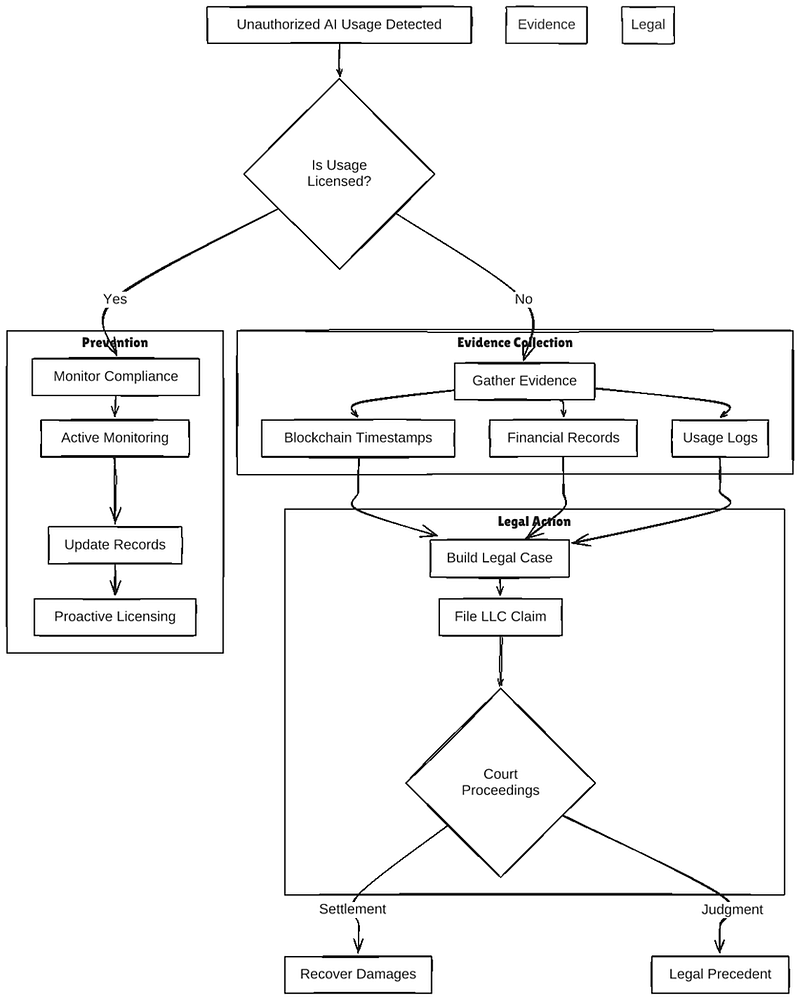
When an AI platform exploits these assets without authorization, the LLC can frame its legal action around misappropriation or unfair competition backed by a cohesive body of forensic evidence. As AI’s influence expands, creators and investors may find that leveraging a structured corporate approach offers stronger legal standing and a clearer route to recovering damages.
These forensics are crucial in supporting legal proceedings and serve as a deterrent for potential infringers. By utilizing these systems, creators can signal their works’ authenticity and ownership, making it clear to potential users that licensing is the proper route to avoid legal disputes. In practical terms, this framework encourages users to seek appropriate licenses in advance, minimizing the risk of legal conflict. With the power of forensics backing their claims, creators can build a more defensible case in the event of a dispute.
Given the robust nature of these tools, any infringement case involving well-documented works would likely be difficult for infringers to win, thus offering a significant deterrent to potential violators. As such, the combination of LLC structuring, legal forensics, and proactive licensing provides a strong foundation for creators to protect and profit from their intellectual property in a rapidly evolving digital landscape.


