
Decentralized Registration, Centralized Administration — A Balanced Approach for Global Music…
In the digital era, music is fundamentally global. Tracks are streamed, sampled, and shared across continents within seconds — for example…


Loading...
Verify on BlockchainDecentralized Registration, Centralized Administration — A Balanced Approach for Global Music Rights Management
In the digital era, music is fundamentally global. Tracks are streamed, sampled, and shared across continents within seconds — for example, Spotify users stream over 100 million songs daily in more than 180 countries. Despite this borderless distribution, the legal and technical systems that govern music rights remain fragmented, territorial, and inconsistent.
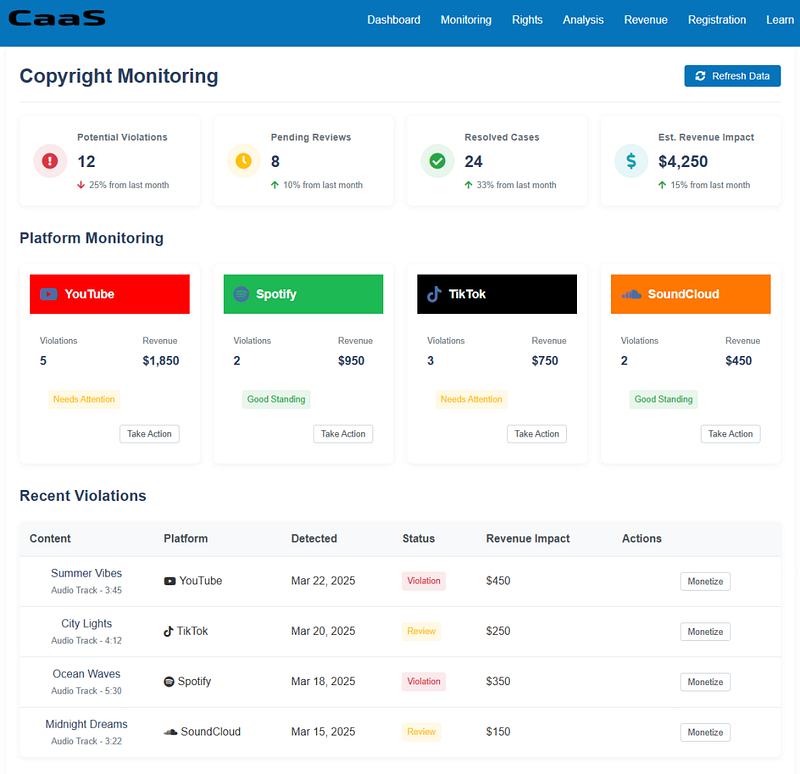
To resolve the disconnect, Copyrighted-as-a-Service (CaaS) offers a hybrid framework that combines decentralized blockchain registration for immutability with centralized administrative infrastructure for coordinated, cross-jurisdictional rights enforcement.
The Case for Decentralized Registration
Blockchain technology provides a transparent and tamper-proof mechanism for registering content ownership. When music assets are registered on-chain, a permanent and verifiable record of authorship, metadata, and licensing terms is created. This public ledger can be independently reviewed by stakeholders across the rights ecosystem, reducing disputes over provenance and enabling more efficient multi-party licensing.
Smart contracts and cryptographic timestamps further strengthen this infrastructure. Once a music asset is registered, its ownership status becomes immutable without consensus. This provides a foundational layer of trust, particularly beneficial in jurisdictions with underdeveloped copyright systems. Integration with existing legal frameworks and performing rights organizations (PROs) enhances interoperability, enabling streamlined validation, simplified licensing, and support for international dispute resolution.
The Enduring Role of Centralized Administration
Decentralization ensures transparency and permanence, but managing music rights requires coordinated operational oversight. Royalties must be tracked, calculated, and distributed; licenses negotiated and enforced; and legal obligations fulfilled across jurisdictions. These tasks are well-suited to centralized entities such as the Mechanical Licensing Collective (MLC), STIM, SACEM, and PRS for Music, SoundExchange, and DDEX, which specialize in managing licensing data, royalty payments, and industry compliance.

CaaS integrates centralized administrative systems via AI agents and enterprise-grade backend infrastructures. These components interface with blockchain-registered metadata, payment processors, tax systems, and collection societies. This dual-function approach preserves the accountability of decentralized data while leveraging the efficiency and scalability of centralized coordination.
Music as a Cross-Jurisdictional Digital Asset
While music flows seamlessly across platforms, copyright law does not. A song registered in one country may be streamed globally, triggering complex royalty and licensing obligations. CaaS addresses this issue by recognizing music as a global digital asset — capable of being registered, licensed, and monitored across borders within a unified infrastructure.

This reclassification enables CaaS systems to facilitate real-time royalty distribution, eliminate redundant administrative tasks, and establish consistent licensing standards across jurisdictions. Through centralized administrative hubs, CaaS supports international tax reconciliation, localized compliance, and timely compensation for rights holders, regardless of where their music is consumed.
Harmonizing Blockchain and Administrative Systems
CaaS is built upon a two-tier architecture: decentralized registration via blockchain and centralized management via AI-driven infrastructure. This hybrid model enables a cohesive rights environment, providing verifiable ownership records and actionable administrative tools. The system currently delivers and continues to develop the following capabilities:
- Immutable ownership verification through blockchain
- Real-time royalty tracking through centralized analytics
- Global licensing workflows enabled by AI-generated contract templates
- Cross-platform enforcement using federated monitoring and detection agents
These components make CaaS a resilient, scalable, and legally grounded solution for today’s dynamic music rights landscape.
Summary
Decentralized registration and centralized administration are not contradictory — they are complementary strategies essential for modern copyright management. CaaS provides a comprehensive framework for global music rights by unifying transparency and verifiability with coordination and compliance. As digital platforms evolve and AI-generated content proliferates, the music industry needs robust infrastructure that can adapt to the complexities of both technological and legal developments. CaaS offers that infrastructure, blending security with interoperability to meet the global demands of the music economy.


