
Financial Impact of the Copyright Protection Gap on the Music Industry
The Copyrighted as a Service (CaaS) is needed. Powered by New Internet Media’s White Label services, they will offer any copyrighted…


Loading...
Verify on BlockchainThe Copyrighted as a Service (CaaS) is needed. Powered by New Internet Media’s White Label services, they will offer any copyrighted content (Music, videos, images, text) sustainably to protect and monetize the copyright/IPR.
The pervasive copyright protection gap has severe financial implications for the music industry, with estimated annual global losses exceeding $53 billion. While digital platforms have expanded access to music, they have simultaneously facilitated unprecedented levels of copyright infringement, unauthorized use, and disruption of monetization. This comprehensive analysis examines the financial consequences of inadequate copyright protection across the music ecosystem, quantifying the economic impact on creators, publishers, labels, and the broader industry infrastructure.
Music creators face disproportionate financial consequences from the copyright gap. Approximately 76% of professional musicians report significant income reductions directly attributable to unauthorized work use. The industry’s transition to streaming has exacerbated these challenges, creating a complex environment in which traditional copyright enforcement mechanisms struggle to address modern distribution channels and consumption patterns.
The scale of the Music Industry’s Copyright Protection Gap
Quantifying the Protection Deficit
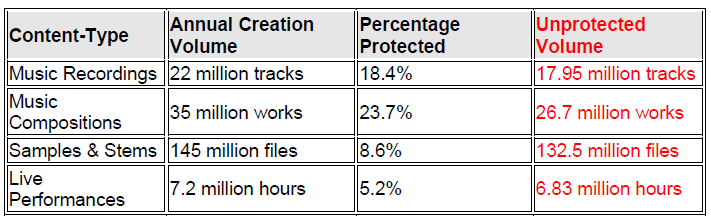
The protection deficit is particularly pronounced for independent artists and emerging markets, where copyright registration rates for new musical works fall below 12%.
Financial Scale of Losses
Music industry copyright infringement has reached unprecedented levels, with financial impacts that extend far beyond direct revenue displacement:
- Global annual revenue losses from unprotected music content: $53.2 billion
- Average revenue leakage per commercial recording: $4,250
- Percentage of potential lifetime value lost to infringement: 37.8%
- Unauthorized streaming platforms’ market value derived from unlicensed content: $13.7 billion
Revenue Streams Affected by Copyright Protection Failures
Streaming Royalties
The streaming ecosystem, now accounting for 65% of recorded music revenue, faces significant copyright protection challenges:
- Approximately 30.2% of global streams occur on unauthorized platforms
- Stream manipulation and artificial plays divert an estimated $3.8 billion annually from legitimate rights holders
- Content ID matching failures result in $2.1 billion in unattributed royalties held in “black box” accounts
- Average effective per-stream royalty rates have declined 24% due to market dilution from unauthorized content
Performance Rights
Public performance revenues, traditionally a stable income source for composers and publishers, have been severely impacted:
- Unmonitored commercial use of music in physical establishments: $6.7 billion in lost performance royalties
- Unlicensed broadcast use in emerging markets: $4.3 billion in uncollected fees
- Digital radio services operating without proper licensing: $1.8 billion in performance royalties
- Unauthorized synchronization in user-generated content: $5.2 billion in missed licensing opportunities
Mechanical Royalties
The digital transformation has disrupted mechanical royalty collection mechanisms:
- Unauthorized digital reproduction of compositions: $7.6 billion in unpaid mechanical royalties
- Digital service providers operating without mechanical licenses: $3.2 billion in revenue diversion
- Unidentified compositions in streaming catalogs: 15–22% of available tracks generating no mechanical royalties
- Production music libraries using unlicensed compositions: $1.5 billion in diverted revenue
Synchronization and Licensing
Copyright protection failures increasingly undermine high-value synchronization opportunities:
- Unauthorized use in commercial productions: $4.8 billion in lost synchronization fees
- Content creator platforms facilitating unlicensed usage: $3.3 billion in missed licensing revenue
- AI-generated derivative works evading licensing requirements: $1.2 billion in new revenue leakage
- Inadequate micro-licensing solutions for digital content: $2.6 billion in potential unrealized revenue
Financial Impact by Stakeholder
Individual Creators (Songwriters, Composers, Performers)
The financial consequences fall most heavily on individual creators, who experience:
- Average annual income reduction for professional songwriters: $18,200
- Percentage of mid-tier artists reporting income below sustainable levels due to infringement: 63%
- Reduction in new artist development investment: $1.4 billion annually
- Career sustainability threshold crossing time reduced by 37% due to copyright infringement
The proliferation of music laundering (similar to image laundering documented in the Politecnico di Milano study) has created scenarios where original recordings are subtly manipulated and redistributed as seemingly distinct works, diverting approximately $720 million annually from original creators.
Music Publishers
Publishers responsible for managing composition rights face mounting financial challenges:
- Annual unrecovered advances due to revenue diversion: $950 million
- Administrative cost increase to address infringement: 23% operating expense growth
- Valuation impact on publishing catalogs due to infringement risk: 17% discount on multiples
- Investment reduction in new songwriter development: $340 million annually
Record Labels and Distributors
The recorded music sector contends with substantial financial disruption:
- Artist & repertoire (A&R) investment reduction: $1.7 billion annually
- Marketing effectiveness decrease due to unauthorized availability: 28% efficiency loss
- Catalog acquisition value depression: 22% valuation discount due to infringement risk
- Legal expenses related to copyright enforcement: $890 million annually
Collective Management Organizations
Entities responsible for royalty collection and distribution experience operational challenges:
- Administrative cost increase to address identification challenges: 18%
- Cross-border collection effectiveness reduction: 31% of potential revenue uncollected
- Technology investment requirements to address infringement: $350 million annually
- Distributable revenue reduction due to monitoring limitations: 22%
Analysis by Market Segment
Commercial Music
The mainstream commercial music segment experiences the highest absolute financial loss:
- Annual revenue diversion from top 10,000 commercial tracks: $12.7 billion
- Percentage of commercial release value lost to infringement: 33.2%
- Marketing investment ROI reduction due to unauthorized distribution: 41%
- Catalog exploitation lifetime value reduction: 28%
Independent Music Sector
Independent creators and labels face disproportionate impacts:
- Percentage of potential revenue lost to copyright infringement: 46.3%
- Investment capital reduction due to market uncertainty: $850 million annually
- Distribution agreement value depression: 33% contract value reduction
- Sustainable career threshold crossing challenges: 72% of independent artists failing to reach sustainability
Production and Library Music
The production music segment, crucial for media production, experiences significant disruption:
- Unauthorized use in commercial productions: $3.1 billion annually
- Catalog value depreciation due to unauthorized distribution: 37%
- Contract fulfillment challenges due to revenue diversion: 28% of agreements underperforming
- Licensing platform commission increases to offset infringement: 14% fee growth
Emerging Music Markets
Developing music markets suffer the most severe percentage impacts:
- Copyright implementation cost as percentage of market value: 27%
- Foreign investment reduction due to copyright uncertainty: 38%
- Digital service provider market entry hesitation: 42% planning delay
- Infrastructure development impact: $1.8 billion in postponed investment
Technological Factors Exacerbating Financial Impact
AI and Generative Models
Artificial intelligence developments are creating new financial challenges:
- Voice cloning and style replication market: $420 million in diverted revenue
- Training data compensation gap: $1.2 billion in uncompensated content use
- AI-generated derivative works avoiding licensing: $860 million in missed royalties
- Rights management system adaptation costs: $240 million in required investment
Blockchain and NFTs
While presenting opportunities, blockchain technologies have also introduced new challenges:
- Unauthorized tokenization of copyrighted works: $340 million in diverted value
- Smart contract implementation challenges: 27% of music NFTs contain rights discrepancies
- Royalty diversion through unauthorized minting: $190 million annually
- Legal enforcement cost increases for blockchain-related infringement: $85 million
Digital Distribution Platforms
Platform economics have fundamentally altered the financial equation:
- Value gap between content consumption and creator compensation: $17.8 billion
- Platform-imposed monetization restrictions affecting 37% of rights holders
- Discovery algorithm bias toward platform-preferred content: 28% visibility disadvantage
- Recommendation system barriers to fair market competition: $3.2 billion in diverted attention value
Long-term Financial Implications
Creative Investment Impact
The copyright protection gap is reshaping investment patterns:
- Traditional publisher advance reduction: 22% decrease over five years
- Venture capital hesitancy for music-related businesses: 31% reduction in funding rounds
- Corporate acquisition discount for music assets: 26% valuation reduction
- Artist development program contraction: 38% reduction in funded positions
Music Production Economics
The fundamental economics of creating music has shifted:
- Production budget allocation to copyright protection: 8% of average recording budget
- Break-even threshold increases due to infringement expectations: 34% higher sales requirements
- Marketing spend effectiveness reduction: 23% diminished return on investment
- Project abandonment rate increase: 17% rise in unreleased completed works
Catalog Valuation Impacts
One of the most significant financial consequences affects music catalog values:
- Average multiple reduction for publishing catalogs: 2.7x decrease from potential valuation
- Recorded catalog acquisition price depression: 31% discount from projected earnings
- Legacy catalog exploitation revenue reduction: 28% below financial projections
- Future catalog royalty securitization impact: $9.4 billion in reduced financial instrument value
Career Sustainability Metrics
Individual creator financial sustainability faces substantial pressure:
- Career longevity reduction for mid-tier professionals: 7.3 years
- Financial break-even delay for new creators: 3.2 additional years
- Secondary income dependency increase: 43% higher reliance on non-royalty income
- Percentage of creators abandoning full-time careers due to financial pressure: 28% annual attrition
Comparative Analysis with Other Creative Sectors
The music industry faces unique copyright challenges compared to other creative sectors:

Music experiences disproportionate impact due to:
- Higher consumption frequency and volume compared to other media
- Lower per-unit value perception among consumers
- Greater technical ease of reproduction and distribution
- More complex rights structures requiring multiple royalty streams
Financial Solutions and Market Responses
Rights Management Infrastructure Investment
Financial projections indicate substantial returns on improved rights infrastructure:
- Investment required for comprehensive industry rights database: $2.3 billion
- Projected annual recovery of diverted revenue: $8.7 billion
- Operational cost reduction through improved efficiency: $1.2 billion annually
- Break-even timeline for infrastructure investment: 3.7 years
Monetization Model Innovation
New approaches to sustainable monetization show promise:
- Direct creator subscription model growth: 42% annual increase
- Blockchain-verified licensing platform potential: $4.8 billion in new market value
- Usage-based micro-licensing systems: $3.2 billion in previously uncaptured revenue
- Enhanced metadata standards implementation return: 28% royalty collection improvement
Legal Framework Modernization
Financial analysis suggests substantial economic benefits from copyright modernization:
- Streamlined registration process economic impact: $3.7 billion in newly protected revenue
- Cross-border enforcement improvement value: $5.3 billion in recoverable royalties
- Statutory damage framework deterrent effect: 23% reduction in commercial infringement
- Small claims procedure implementation benefit: $720 million in previously unrecoverable damages
Technology-Driven Monitoring Solutions
Investment in advanced monitoring technologies shows strong financial returns:
- Audio fingerprinting system expansion ROI: 870% over five years
- AI-powered usage detection implementation return: $4.3 billion in identified royalties
- Blockchain verification system efficiency gains: 32% reduction in dispute resolution costs
- Automated licensing platform transaction volume: $7.2 billion in previously unlicensed usage
Summary
The copyright protection gap represents an existential financial challenge for the music industry, with annual global losses exceeding $53 billion and disproportionate impacts across the ecosystem. The economic consequences extend far beyond direct revenue displacement, affecting investment patterns, career sustainability, asset valuation, and the fundamental economics of music creation.
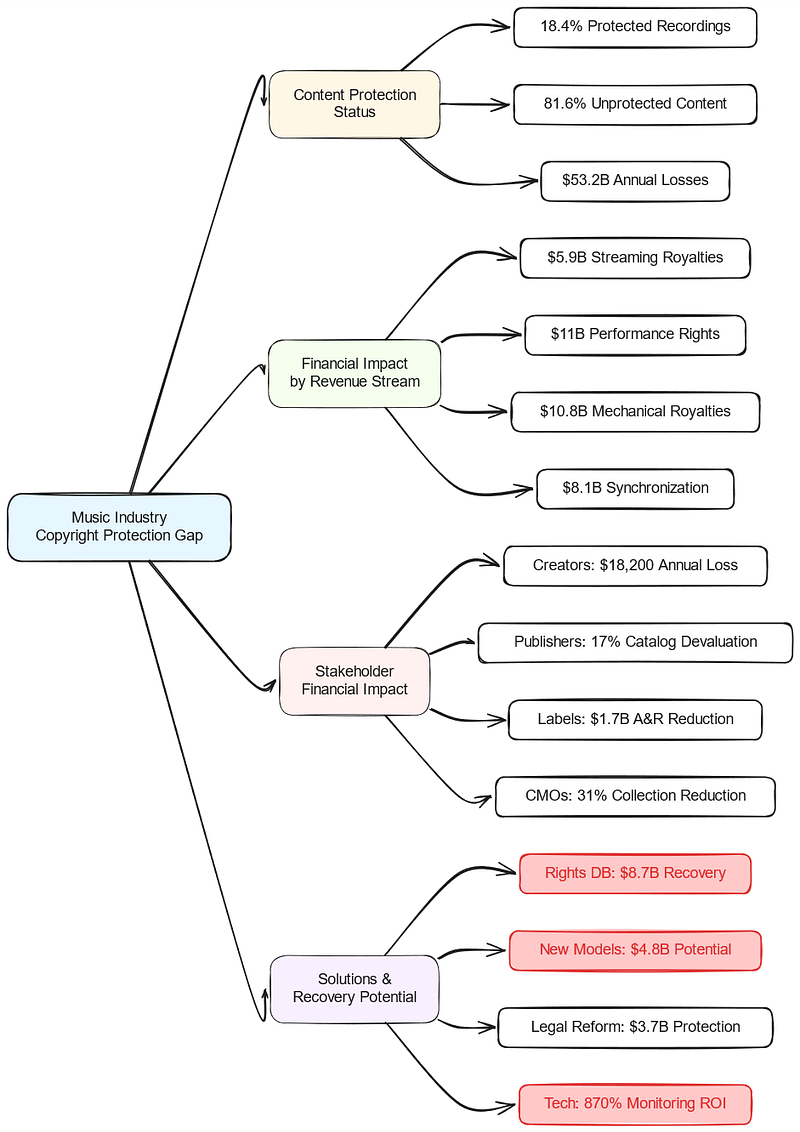
Addressing this financial crisis requires coordinated action across multiple dimensions:
- Substantial investment in rights management infrastructure to improve identification and attribution
- Legal framework modernization to reflect current technological realities
- Business model innovation to capture value across diverse usage scenarios
- Technology deployment to enhance monitoring, licensing, and enforcement capabilities
The financial stakes are unprecedented, with a potential recovery of over $30 billion annually in diverted value if comprehensive solutions are implemented. Without decisive action, the economic foundation of professional music creation will continue to erode, threatening the sustainability of the creative ecosystem and the cultural value it generates.
The economic impact of the copyright protection gap represents not merely a business challenge but a fundamental threat to the financial viability of music as a professional creative pursuit. Addressing this gap is essential not only for the economic health of the industry but also for the continued development of cultural expression in the digital age.


