The end of apps. Why your music catalog’s problem is actually an $85 million valuation problem
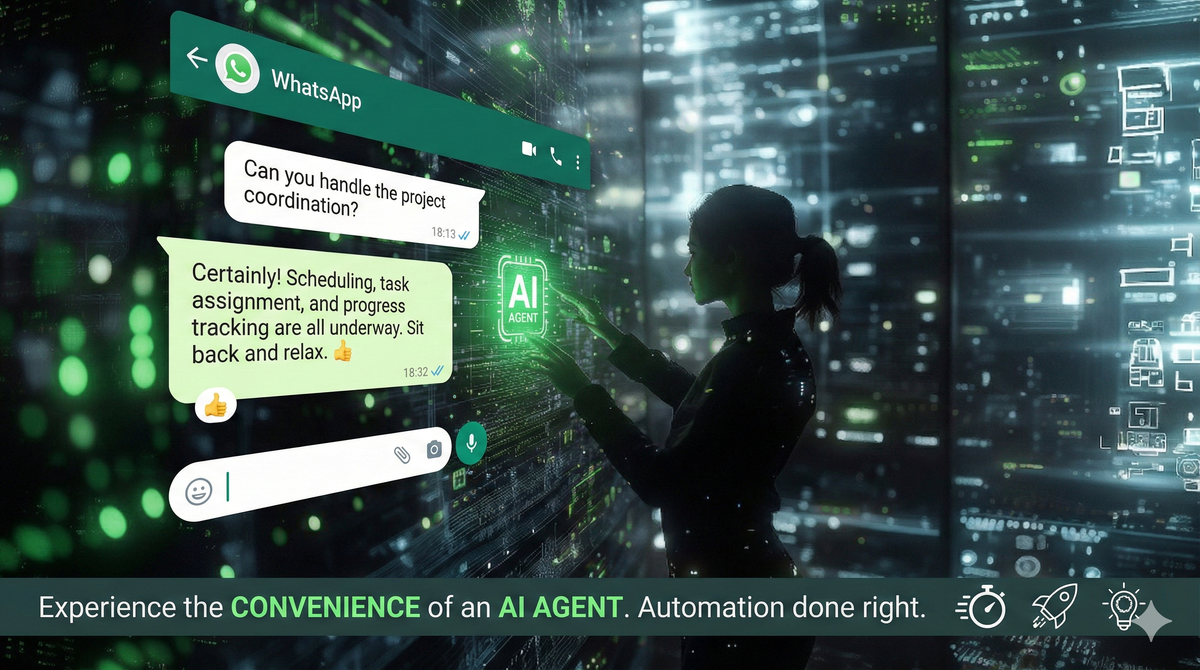
You can now write a WhatsApp message saying : “Pull my royalties stats for Brazil, assess them against the projected income from my Brazilian music publisher, and email my manager telling him to follow up!”

Loading...
Verify on BlockchainThe shift is not about a new iPhone or Google update. It is about artificial intelligence crossing the line from language generation to autonomous action. When you can send a WhatsApp message saying “Find me up-tempo jazz with female vocals cleared for commercial sync, budget under $5K” and receive three licensed options with instant settlement in 60 seconds, traditional apps suddenly look like obsolete roadblocks charging rent for friction.
NIM is launching WhatsApp community, which represents a fundamental rethinking of the user experience.
- No desktop required.
- No portal login.
- No menu navigation.
You send a note. The agent runs silently in the background and delivers results directly to your chat feed.
The public WhatsApp group NIM Talk is a fine place to start
For music catalogs, this conversational interface creates a brutal valuation reality: institutional investors deployed $20 billion into music rights since 2019, but an 11.2x valuation spread now exists between catalogs with identical music but different accessibility infrastructure.
Clean metadata that NIM Agents can parse through WhatsApp commands a 13x premium over songs buried in legacy portal systems.
When a music supervisor can license tracks through the same chat interface they use for everything else, every catalog requiring traditional app navigation becomes functionally invisible. The agent cannot recommend what it cannot access conversationally. Settlement velocity alone creates the difference between receiving $85 million versus $68 million annually from a $100 million catalog—that $17 million gap is the cost of maintaining app-based friction in an agent-mediated economy.
The copyright licensing market is projected to grow from $3.81 billion to $1.854 trillion by 2035. The catalogs capturing that growth are not the ones with the best mobile apps. They are the ones whose infrastructure responds to natural conversation in WhatsApp while someone grabs coffee.
Infrastructure quality is the new alpha.
App-dependent user experience is the new liability.
Conversational accessibility through platforms people already use daily is not just better user experience; it is the difference between being discoverable and being invisible to the AI systems that determine which music generates revenue.
Your favorite applications are about to become invisible.
From talkers to doers.
- In 2022, we marveled at chat windows.
- In 2025, we obsessed over compute efficiency.
- In 2026, the conversation shifted entirely to execution.
Until now, AI acted like a consultant sitting in a browser tab. It gave advice, but you did the work. NIM Agents operate differently. They function as digital employees with action rights, directly accessing your files, contacts, and browser. The value of digital assets is shifting overnight. Software is no longer measured by the features its code provides, but by an agent’s ability to successfully execute human intent.
Think about music discovery.
When a music supervisor asks an AI to find “an uptempo jazz track with female vocals for a coffee shop scene,” the system does not return any matches for those keywords. It constructs a semantic representation in a high-dimensional vector space and searches for tracks whose metadata occupy nearby coordinates.
Traditional metadata like title, artist, duration, genre provides almost no signal. Without rich, machine-readable semantic descriptions of mood, instrumentation, tempo, scene suitability, and licensing terms, a perfect track remains invisible. It does not rank low. It does not appear at all.
Catalog utilization sits at 2-3% for conventionally indexed music. After implementing structured semantic metadata, that figure climbs to 8-12%.
The tracks themselves have not changed.
The infrastructure surrounding them has.
One platform with 12 million tracks received fewer than 100 AI crawler visits per week. Competitors with AI-native architecture received one visit per second. The difference was not in content quality. It was infrastructure.
The interface of the future is like WhatsApp
Graphical user interfaces are incredibly heavy. Every button, menu, and visual element adds friction between your intention and the result.
NIM has moved much of its operation to WhatsApp, and the reason is brutally practical.
In areas with terrible internet connections, visually heavy apps completely paralyze the workflow. Text-based messaging pushes commands through perfectly. You send a voice note while walking down the street: “Pull my royalties stats for Brazil, assess them agains the projected income from my Brazilian music publisher, and email my manager telling him to follow up on any discrepancies.”
The agent runs silently in the background, treating your desktop as an invisible container.
This represents a massive phase shift in compute usage. You no longer need to sit at a desktop wrestling with interfaces. The work happens behind the scenes. You receive results through the same conversational channel you use for everything else.
Shattering the walled garden
For the last decade, data was “protected” by building walled gardens. It was controlled access through Application Programming Interfaces that could be opened or restricted at will.
NIM Agents render APIs obsolete through what developers call “slow interfaces.”
If a human can see a webpage, an agent with computer vision can see it too. The agent physically clicks buttons and fills forms exactly as you would. When a platform shuts down its API to block third-party developers, the agent simply opens a browser and navigates the site visually. It can even click the “I am not a robot” CAPTCHA boxes.
Consequently, up to 80 percent of consumer apps will become redundant. You will not need the Delta, Uber Eats, or banking app. The agent extracts value from their underlying web pages and delivers results directly to your chat feed.
The music industry provides the clearest example of what happens when walled gardens fall.
Streaming platforms settle transactions in real time.
Payment infrastructure settles quarterly.
Rights holders wait 6 to 18 months for royalties, while approximately $2.5 billion sits annually in “black box” accounts, money collected but unattributable because metadata is incomplete or contradictory.
Collection societies charge 15 to 25 percent administrative overhead for processes that blockchain-based systems accomplish at below one percent.
When agents can navigate directly to the source of value, every intermediary charging rent for access suddenly faces an existential problem.
The elephant in the room! Security and sabotage
Giving an AI system-level access to your information sounds like a catastrophic security nightmare.
You are entirely correct. This is the biggest objection to the agentic revolution, and it is valid.
Traditional firewalls cannot stop natural language vulnerabilities. The defense strategy is shifting from rigid walls to what we call “obfuscated governance.” Agents receive private, custom instruction sets, digital personalities that make them harder for malicious actors to manipulate.
Security in 2026 is not about absolute prevention. It is about dynamic resilience.
The music industry’s fraud problem illustrates the economic challenge perfectly. Generating fake streams costs near-zero.
Bot networks run on a few hundred dollars in cloud computing per month.
Enforcing against fraud costs $5,000 to $50,000 per case through traditional legal channels.
Apple Music blocked two billion fraudulent streams in 2025.
Detection works.
The economics do not.
Fraud remains rational because expected profit exceeds expected cost by orders of magnitude.
The alternative is not better detection. It is a different economy.
Micropayment protocols that charge $0.02 per API query make mass automated fraud expensive at scale. A bot making one million queries now costs $20,000 before generating a single fraudulent stream.
The legitimate user who makes 10 queries pays 20 cents. Reputation-staking mechanisms requiring $10,000 in collateral against $100 claims create 100:1 risk ratios that make fraud a guaranteed loss rather than a probabilistic gain. Identity registries built on permanent records make account disposal costly.
These mechanisms impose costs at the moment of fraudulent activity rather than months later through legal proceedings. Security becomes economic rather than defensive.
The training window problem nobody talks about
AI discoverability carries urgency that traditional software never did.
- Search engines crawl continuously. A website optimized today appears in results tomorrow.
- AI language models train on fixed datasets at fixed intervals. The training data cutoff determines what the model knows for the next two to three years of operational life.
Music infrastructure absent during training remains invisible, even after subsequent optimization, until the next cycle. Missing one window means missing two to three years of AI-mediated revenue.
For agents navigating services on your behalf, the same principle applies.
The services and data sources that AI understands during training become embedded knowledge. The services it misses remain invisible or inaccessible until the next training cycle. Infrastructure deployment is not continuous. It is episodic, with compounding consequences for early visibility or early invisibility.
The 118-subscriber arithmetic that makes sense
When discovery infrastructure works and fraud economics are corrected, a different model of sustainability emerges.
The arithmetic is specific: 118 active subscribers paying $10 per month through a platform that retains 85 percent of revenue for the artist generate $1,003 monthly, matching the income from 200,000-334,000 Spotify streams.
Not 118,000 subscribers. 118 people who value an artist’s work enough to maintain a recurring subscription.
A community smaller than most wedding guest lists.
AI-mediated discovery feeds this directly.
When an agent recommends an artist based on specific aesthetic criteria, the listener arrives with intent. Conversion from AI-referred discovery is substantially higher than from passive playlist exposure because the initial engagement is purposeful.
This inverts the traditional platform economy. Instead of artists paying platforms for visibility through promotional spend, the AI actively works to connect every track with every potential listener whose described preferences align.
Discovery becomes a function of match quality rather than marketing budget.
What this means for the rest of us
The music industry’s infrastructure crisis is a preview. Every industry with intermediaries charging rent for access, settlement delays creating float, and discovery dependent on proprietary platforms faces the same restructuring.
When autonomous agents can navigate service conversations conversationally on WhatsApp, execute transactions directly, verify authenticity with cryptographic proofs, and operate at near-zero marginal cost, the value of traditional applications collapses. The interface disappears. The middleman becomes optional. The settlement cycle drops from months to seconds.
The organizations building agent-compatible infrastructure now are establishing positions that compound with each AI training cycle. The ones treating this as a distant concern are becoming invisible in discrete steps that correspond to training data cutoffs.
The infrastructure is invisible by design. Users do not see metadata schemas or settlement protocols. But every recommendation, payment, and transaction flows through these systems. The difference between being discoverable and being invisible is not gradual. It is binary. The agent can represent you in its operational model, or it cannot.
The apps on your screen are not going to slowly fade away. They will become unnecessary the moment an agent can accomplish the same task through natural conversation without requiring you to remember which icon to tap.
That moment is not coming.
It is here.
The friction you currently accept as normal is about to feel absurd.