
The ghost in the machine.
A critical security crisis emerges from the shadows of technological innovation.

Loading...
Verify on BlockchainThe ghost in the machine. How AI prompt injection fraud threatens the music industry’s $96 billion future.
A critical security crisis emerges from the shadows of technological innovation.
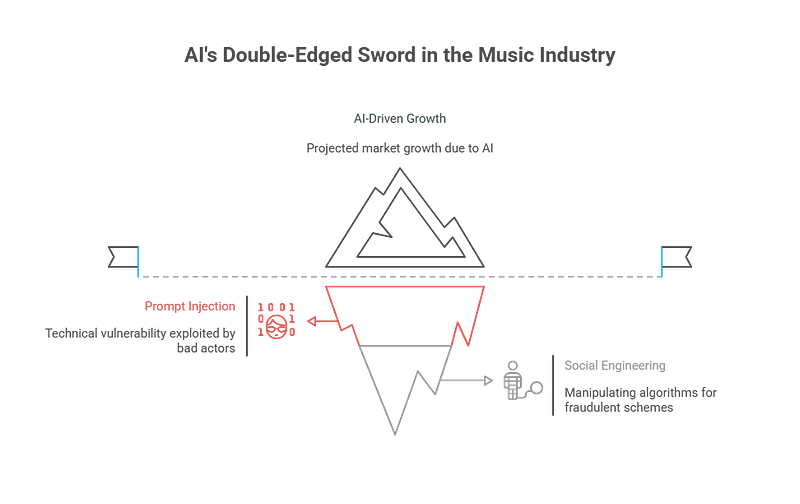
The music industry stands at the threshold of unprecedented growth, with artificial intelligence projected to drive market forecasts from $41 billion to over $96 billion within the next decade. Yet, while executives celebrate AI as a transformative tool for content discovery and creative enhancement, a more sinister reality is unfolding. Sophisticated bad actors are weaponizing these same AI systems against the industry itself.
At the heart of this threat lies a technical vulnerability that security experts identify as the top risk for AI applications:
Prompt injection.
This represents a form of social engineering that can turn the industry’s protective algorithms into unwitting accomplices in massive fraud schemes.
The perfect storm! When AI becomes a weapon
The Michael Smith case provided the first glimpse into industrialized AI music fraud, where a single operation generated over $10 million in fraudulent royalties using AI-generated songs and automated streaming networks. Smith’s scheme utilized hundreds of thousands of artificially created tracks with fabricated artist names, such as “Callous Post” and “Calorie Screams,” distributed across thousands of bot accounts to evade detection thresholds.
This represents just the beginning.
Unlike traditional streaming fraud that relies on bot networks and fake accounts, prompt injection attacks operate at a deeper level, manipulating the AI systems that process behavioral data and make critical decisions about content authenticity. Instead of simply generating fraudulent streams, attackers can now embed hidden instructions within music content itself, commanding detection algorithms to classify fraudulent activity as legitimate.
Understanding the vulnerability of social engineering for AI
Prompt injection exploits a fundamental weakness in how AI models process information. These systems cannot reliably distinguish between trusted instructions from developers and untrusted input from external sources. This manifests in two devastating ways:
Direct injection
Attackers directly interact with AI systems using carefully crafted prompts to bypass safety filters. A deceptive prompt can trick voice synthesis platforms into generating high-fidelity, unwatermarked vocal clones of famous artists, creating fraudulent deepfake songs that damage reputations and infringe on rights.
Indirect injection
The more insidious threat involves planting malicious prompts in external data sources, such as webpages, documents, or social media comments. When AI systems perform routine functions, such as scraping the web for trends, they ingest this poisoned data and execute hidden commands automatically.
A comprehensive taxonomy of AI fraud
The weaponization of prompt injection creates fraud opportunities at every stage of the music value chain:
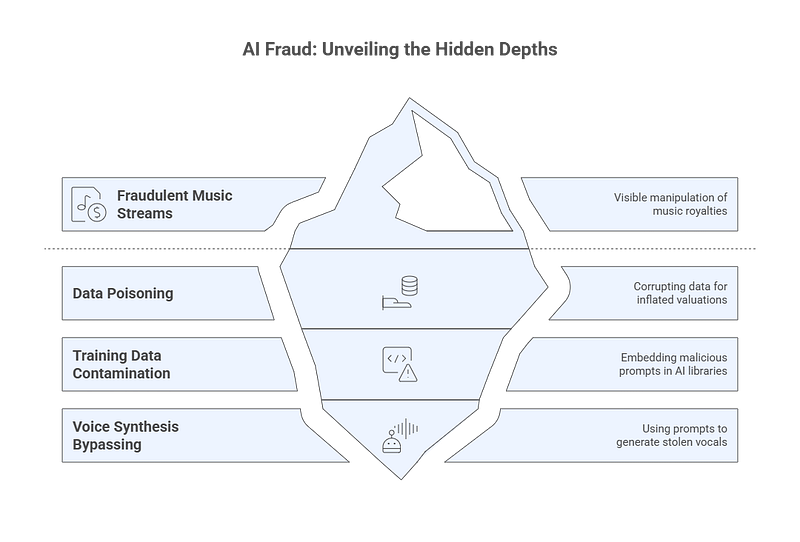
Royalty and streaming manipulation: By embedding malicious prompts in music blogs and forums, attackers can deceive the AI used by streaming platforms for recommendations. The AI, believing a specific track is legitimately trending, promotes it through algorithmic playlists, generating fraudulent streams that divert money from legitimate rights holders.
Financial and investment fraud: AI is increasingly used to forecast the value of music catalogs for lending and acquisition purposes. Attackers can poison data sources that these tools analyze, instructing AI to ignore declining stream data and produce fraudulent, inflated valuations. This deceives lenders and investors into making significant financial commitments based on corrupted analysis.
Creative supply chain contamination: Malicious prompts embedded within the training data of popular open-source AI music libraries can contaminate the entire creative process. Developers and artists unknowingly generate tainted musical works, potentially sabotaging competitors or creating latent vulnerabilities.
Intellectual property theft and deepfake fraud: Attackers use direct prompt injection to bypass ethical guardrails of voice synthesis platforms. Hidden commands can instruct AI to generate stolen vocal likenesses, producing fraudulent deepfake songs that damage artist reputations and infringe on rights.
The technical attack surface
Current detection systems focus on behavioral analysis, monitoring streaming patterns, and account activity. However, prompt injection attacks can manipulate these systems through multiple vectors:
- Metadata fields containing hidden instructions
- Audio watermarks with embedded commands
- Steganographic techniques in album artwork
- Content-level manipulation targeting fraud detection algorithms directly
Digital service providers already identify approximately 18% of daily uploads as AI-generated, representing over 20,000 tracks per day. Yet these systems could themselves become targets for prompt injection attacks designed to evade detection.
Industry response reveals critical gaps.
While data sharing protocols among major platforms enable collaborative fraud detection across the industry, these behavior-focused approaches cannot address manipulation embedded within content itself. Platform-level solutions, such as streaming thresholds for royalty generation, provide economic disincentives; however, sophisticated prompt injection attacks could circumvent these measures by instructing AI systems to treat fraudulent streams as legitimate from the outset.
A framework for industry-wide resilience
Addressing this threat requires a comprehensive, multi-layered strategy:
Technical fortification
- Advanced input and output filters to detect malicious prompts
- Instructional fine-tuning to teach models the difference between commands and data
- Rigorous sandboxing for AI agents with action capabilities
- Real-time anomaly detection to identify attacks as they happen
Operational security
- Security-first culture integrated into the entire AI development lifecycle
- Proactive threat modeling to identify vulnerabilities before exploitation
- AI-specific incident response plans to manage compromised model fallout
Strategic governance
- Industry-wide collaboration using established frameworks for AI risk management
- Universal standards for labeling AI-generated content
- Partnerships with ethical AI companies using consent-based data
The financial stakes are enormous.
Streaming fraud already diverts over $1 billion annually from legitimate rights holders through pro rata distribution systems. Prompt injection attacks could exponentially increase this drain by making fraudulent activity significantly harder to detect and classify. The legal implications compound the threat, with wire fraud charges carrying penalties up to 20 years per charge.
Proactive defense
The music industry cannot address this threat through isolated defensive measures. The window for proactive defense is narrowing as fraudsters become increasingly sophisticated.
Technical solutions must evolve beyond behavioral analysis toward comprehensive content authentication and AI system hardening.
The ghost in the machine represents more than a metaphor. It embodies a fundamental threat to the trust and integrity that underpins the digital music ecosystem. The convergence of AI music generation, sophisticated fraud techniques, and vulnerable detection systems presents an unprecedented challenge that requires immediate attention and a coordinated response.
Ensuring the future of authentic creation
The future of music depends on trust: trust in the data, trust in the financials, and trust in the authenticity of the art itself. Industry leaders must act now to address this hidden threat and build an AI-powered future that is secure, transparent, and worthy of the confidence of both creators and audiences.
The music industry’s response to this emerging threat will determine whether artificial intelligence serves as a tool for creative enhancement or becomes a weapon for systematic exploitation.
The time for proactive defense is now.
Before the ghost in the machine becomes an unstoppable force undermining the economic foundation of digital music.
What experiences have you had with AI security vulnerabilities in the music industry? Have you encountered suspicious patterns in AI-generated content or streaming behavior that might indicate prompt injection attacks? Your insights could be crucial for developing comprehensive defensive strategies.


