
The rise of private markets — closing the copyright gap and unlocking new value.
Private markets — including private equity, private credit, infrastructure, and, increasingly, intellectual property — have evolved from…

Loading...
Verify on BlockchainPrivate markets — including private equity, private credit, infrastructure, and, increasingly, intellectual property — have evolved from niche alternatives into essential pillars of modern investment portfolios. Beyond providing diversification and enhanced returns, they now serve as a powerful mechanism to address persistent structural gaps, particularly the widespread under-protection and under-monetization of copyrighted content across digital platforms.
From margins to mainstream — the private market evolution
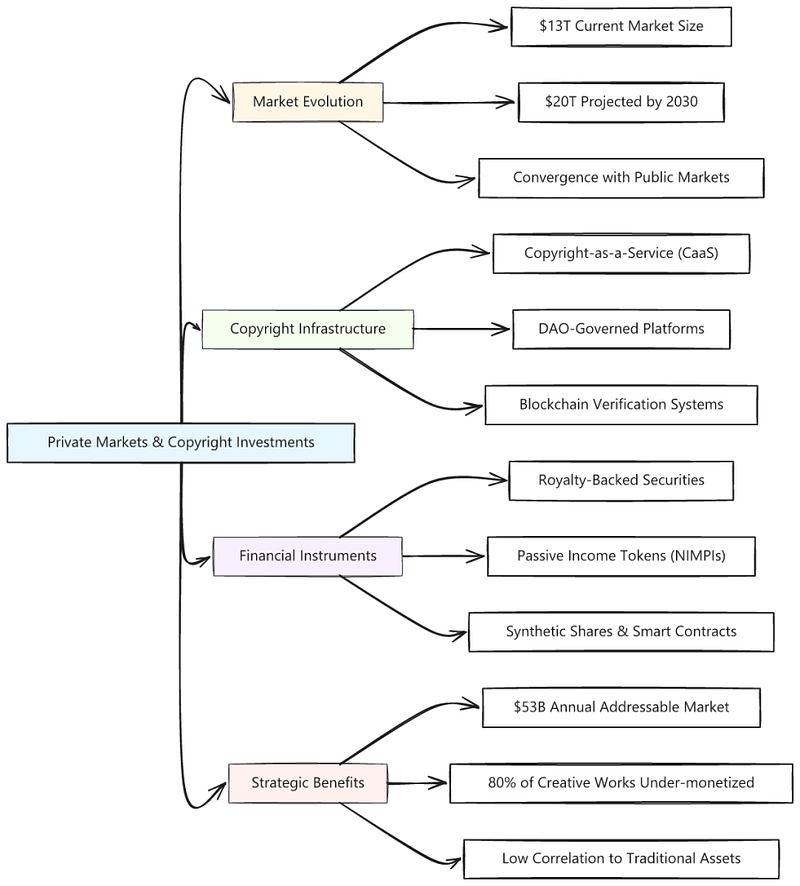
Once seen as illiquid and exclusive, private markets have matured into a $13 trillion segment of the financial system, with projections to surpass $20 trillion by 2030. This expansion is driven by longer lifecycles of private companies and growing capital requirements across AI, digital infrastructure, and creative industries.
Vidy Vairavamurthy, a portfolio manager at BlackRock, notes that public and private markets are converging into a seamless spectrum of risk and return. Today’s private assets encompass infrastructure, venture capital, and emerging sectors, such as intellectual property, an underutilized category with untapped potential. From the Podcast: https://youtu.be/HEqbOSQQJC4?si=M4-mHpgsUYnXn2wb
Private capital meets copyright protection.
One of the most transformative uses of private capital lies in scaling copyright infrastructure. Models such as Copyrighted-as-a-Service (CaaS) enable creators to register, verify, tokenize, and monetize their works. For instance, a music catalog can be bundled and sold as a royalty-backed security, distributing revenue to investors via automated smart contracts.
Synthetic financial structures — such as New Internet Media’s Passive Income Tokens (NIMPIs) — extend this model. Unlike traditional securities that confer ownership, NIMPIs are programmable synthetic shares offering fractional claims on future royalty income. These tokens, supported by blockchain infrastructure, enable real-time settlement, consistent income streams, and borderless accessibility.
This framework does more than empower creators — it addresses an estimated $53 billion in annual lost revenue due to unauthorized content use and royalty misallocation.
By reframing copyright as a securitizable asset, private markets help preserve culture while unlocking sustainable yield.
Access to niche asset classes
Private capital is no longer confined to institutional investors. Through semi-liquid vehicles and blockchain-enabled marketplaces, broader audiences can now access niche assets, such as intellectual property. Synthetic liquidity enables the instant trading of these income rights via smart contracts, converting traditionally illiquid royalties into flexible, yield-bearing financial instruments.
Paul Braude, Managing Director at BlackRock, emphasizes that private capital’s adaptability suits emerging segments such as decentralized media, royalty-based securities, and digital monetization platforms — all foundational to a next-generation investment thesis.
Rethinking diversification — the “alternatives to alternatives”
Assets such as music catalogs, streaming rights, and AI-generated content correlate poorly with traditional equity and bond investments. These alternatives to alternatives not only provide financial upside but also contribute to a resilient and inclusive digital economy.
With over 80% of creative works undermonetized — a figure supported by recent industry analyses — the potential for value capture is massive. Using DAO-governed platforms and stablecoin-denominated payouts, NIM and its ecosystem peers are building equitable frameworks to distribute income, track rights, and automate enforcement at scale.
Strategic fit with private markets in portfolio construction
The case for private markets in today’s portfolios includes:
- Return Enhancement: High-yield potential from royalty-generating IP assets and programmable synthetic instruments.
- Diversification: Low correlation to public markets and traditional fixed income.
- Impact Alignment: Direct investment in copyright infrastructure supports fair creator compensation and digital equity.
Closing the protection gap is a structural imperative
The under-monetization of IP is a structural market failure, not a marginal inefficiency. Today, over 80% of global music and digital works remain either unlicensed or improperly compensated. CaaS platforms, DAO-governed Series LLCs, and token models like NIMPI offer transparent, compliant, and immediate remedies.
These solutions integrate legal certainty, blockchain verifiability, and programmable finance, transforming IP into a tradable and investable asset class. This strengthens the creator economy while providing differentiated exposure for investors.
Bridging capital and culture
Our ability to align capital markets with cultural and creative innovation will define the coming decade. When designed for accessibility and fairness, private markets provide the infrastructure to bridge the copyright gap and foster a vibrant digital economy.
With the real-world asset (RWA) token market expected to surpass $16 trillion by 2030, IP-backed tokens and synthetic shares represent one of the most compelling frontiers. Royalty-bearing instruments have the potential to outperform traditional income assets while connecting investors to the exponential value of digital media.
By integrating IP-backed assets into private market strategies, investors gain differentiated returns and the opportunity to shape a fairer and more dynamic Internet economy — one in which content is collateral, creators are founders, and culture is capital.


