The silence that pays better than a song. Analysis of playlists reveals the scale of streaming fraud.
Streaming fraud has long been a known issue in the music industry. While many recognize the presence of artificial streaming, precise measurement is rare, and effective solutions are even rarer.


Loading...
Verify on BlockchainNIM has gone beyond merely discussing the problem to actively measuring it by building a fraud-detection engine to analyze it. The data generated offers a clear picture of the scale of the problem.
Due to the sensitive nature of our detection algorithms, access to the fraud detection dashboard is limited (fraud.copyrightchains.com)
Critical risk identification across the ecosystem
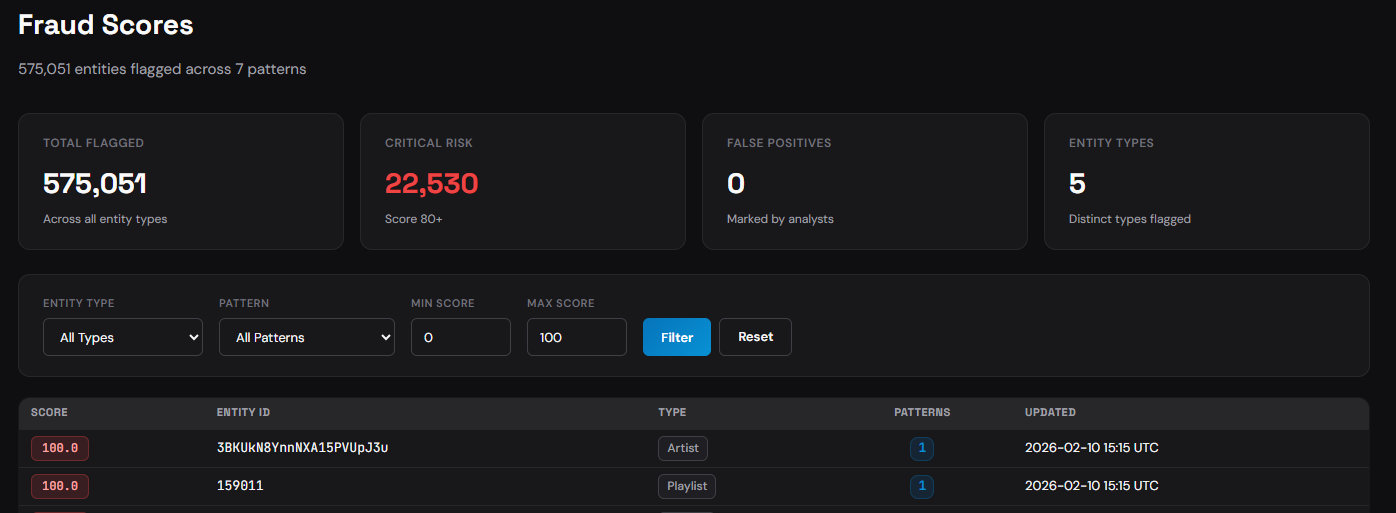
The system examined 575,051 entities, including tracks, playlists, artists, albums, and playlist owners. Seven fraud detection algorithms were applied simultaneously to this data, producing a risk score ranging from 0 to 100 for each entity.
The analysis identified 22,530 entities with scores of 80 or above, marking them as critical risk. These high scores reflect strong, multi-signal evidence of fraudulent activity rather than minor anomalies. An additional 155,219 entities scored between 60 and 79, classifying them as high risk needing further investigation. The data show that roughly one in three entities in the analyzed set exhibit significant indicators of fraud.
The mechanics of modern streaming fraud
Fraud strategies have become more advanced, involving complex, multi-layered techniques that go far beyond basic bot attacks.
- Playlist farms operate as networks of bot-curated playlists. A single operator creates playlists, generating millions of artificial streams, funneling royalties to specific tracks under their control.
- Track stuffing involves flooding the platform with short, auto-generated content. Fraudsters upload thousands of tracks just over the 30-second royalty threshold and utilize bot networks to stream them continuously.
- Coordinated networks consist of account clusters behaving with suspicious synchronization, such as following identical playlists or streaming the same tracks simultaneously.
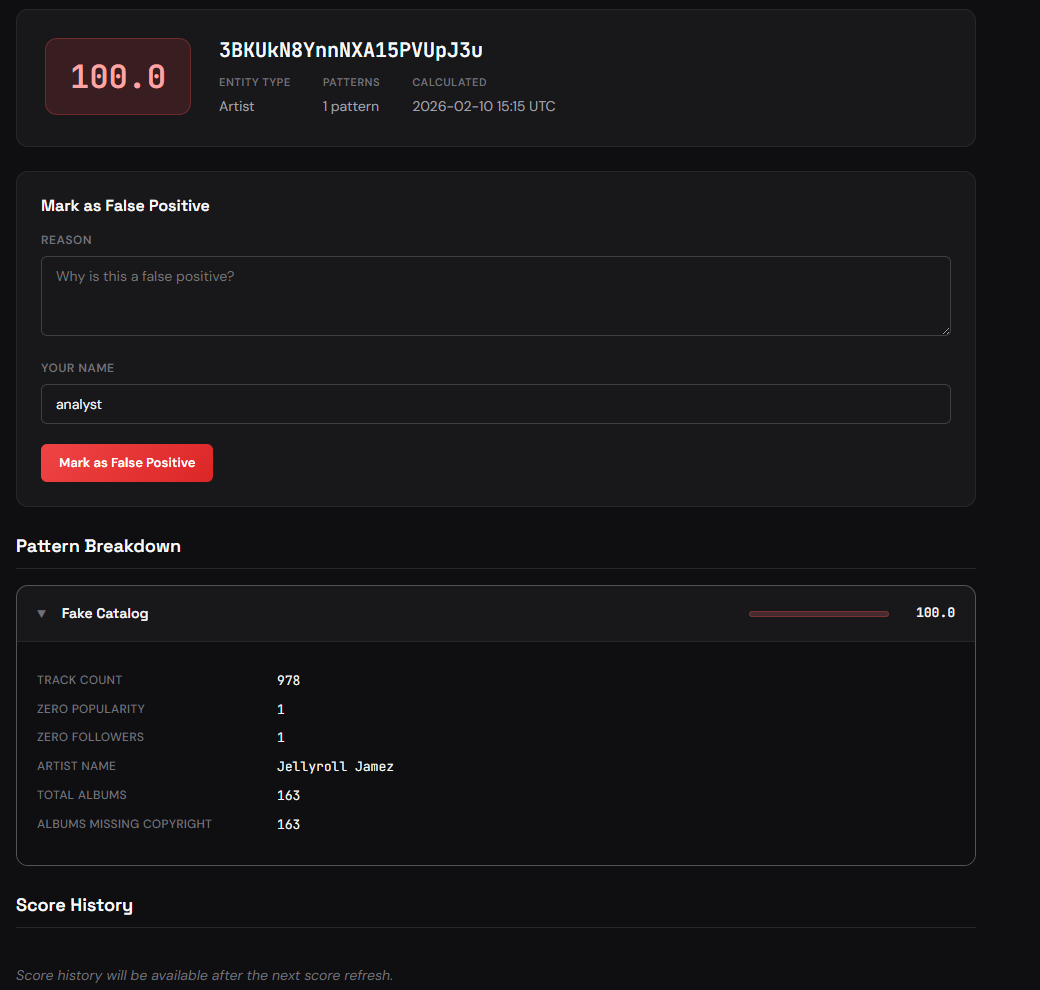
- Fake catalogs appear as complete artist profiles but exist solely to capture revenue, often utilizing AI-generated audio or repurposed ambient noise.
Multi-dimensional pattern detection
Effective detection requires recognizing these patterns together, since fraud is rarely one-sided. Operators of playlist farms often exhibit temporal anomalies, such as streaming at unusual hours, along with coordinated network activity and metadata inconsistencies.
The CopyrightChains platform utilizes seven specific detection algorithms:
- Playlist farm detection: Identifies networks of bot-curated playlists.
- Track stuffing analysis: Flags artificially inflated catalogs.
- Coordinated network detection: Locates accounts operating in concert.
- Fake catalog identification: Detects fabricated artist profiles.
- Royalty farming detection: Uncovers systematic royalty manipulation.
- Temporal anomaly analysis: Identifies unnatural streaming time patterns.
- Label and copyright gap detection: Locates inconsistencies in metadata.
In addition, we have identified 5 other less common detection algorithms that we will not disclose, as they underpin an increasingly sophisticated setup and are directly related to our work on creating a more AI- and search-friendly architecture.
A composite score synthesizes these findings. While a single flag may represent a coincidence, multiple concurrent flags provide a definitive signal of fraudulent activity.
Operationalizing fraud intelligence
Data requires accessibility to drive action.
The CopyrightChains analyst dashboard offers live, interactive access to real-time data, allowing investigators to filter 575,000 entities by risk level, pattern, and type. The system enables drilling down into specific evidence for each score, marking false positives to improve institutional knowledge, and monitoring score changes over time. Authorized stakeholders access this intelligence through a role-based security system.
Economic impact and future deployment
Fraudulent streams directly drain the limited royalty pool, reducing payments to legitimate rights holders. Independent and mid-tier creators, who lack the resources to fight systemic abuse, suffer the most financial damage. By detecting fraud at scale, the platform guarantees royalties go to the content creators who earned them.
Future development will broaden the system beyond the initial scope to include more streaming platforms, shift from batch analysis to real-time monitoring, and integrate with modern rights management systems.
This initial step in building a comprehensive transparency infrastructure is a core issue for our partners.
Technical architecture (public)
The platform applies seven distinct detection algorithms simultaneously across the streaming data graph.
| Detection pattern | Target activity |
|---|---|
| Playlist farm | Bot-curated playlist networks |
| Track stuffing | Artificially inflated catalogs |
| Coordinated network | Multi-account fraud rings |
| Fake catalog | Fabricated artist/album profiles |
| Royalty farming | Systematic royalty manipulation |
| Temporal anomaly | Unnatural streaming time patterns |
| Label and copyright gap | Metadata inconsistencies signaling fraud |
The system assigns a composite fraud score to each entity, ranging from 0 to 100, by synthesizing signals from all applicable patterns. This allows analysts to review the specific evidentiary data supporting each score.
Current detection metrics
As of February 2026, the platform has generated the following analysis:
| Metric | Value |
|---|---|
| Total entities flagged | 575,051 |
| Critical risk (score 80+) | 22,530 |
| High risk (score 60–79) | 155,219 |
| Detection patterns running | 7 |
| Entity types analyzed | 5 |
Breakdown by entity type:
| Entity type | Count |
|---|---|
| Tracks | 328,676 |
| Albums | 134,846 |
| Playlists | 72,321 |
| Artists | 33,682 |
| Playlist owners | 5,526 |
The data confirms that fraud permeates the entire ecosystem, affecting individual tracks, albums, and the playlist owners distributing them.