
Tornado Cash Ruling: Defining Boundaries and Opening Doors for Blockchain Copyright Protection.
The recent Fifth Circuit Court ruling on Tornado Cash raises significant implications for decentralized software platforms like…


Loading...
Verify on BlockchainThe recent Fifth Circuit Court ruling on Tornado Cash raises significant implications for decentralized software platforms like CopyrightChains, particularly regarding regulatory overreach, classifying smart contracts as property, and the impact on transparency and accountability in blockchain applications. The court found that OFAC overstepped its authority by sanctioning Tornado Cash, an open-source, immutable smart contract on the Ethereum blockchain. The key argument was whether these smart contracts could be classified as “property” subject to sanctions under the International Emergency Economic Powers Act (IEEPA). The court concluded that Tornado Cash’s immutable smart contracts are not property because they cannot be owned or controlled, distinguishing them from other tangible or intangible assets typically considered property.
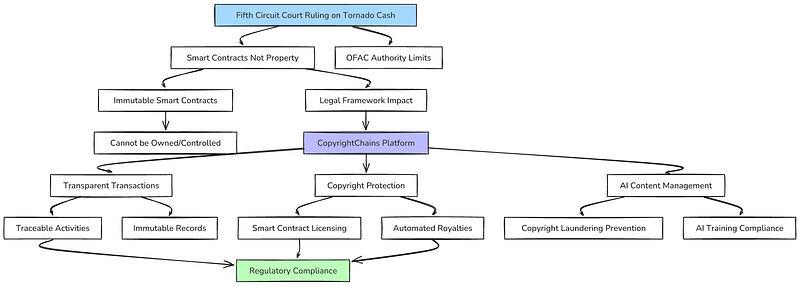
This ruling is highly relevant to CopyrightChains, which utilizes blockchain-based technologies to protect and enforce copyright rights within the creative ecosystem. Unlike Tornado Cash, which anonymizes transactions, CopyrightChains focuses on transparency, traceability, and accountability. CopyrightChains’ infrastructure is designed to empower rightful copyright owners, enabling them to assert and enforce their rights effectively. By ensuring that transactions are recorded immutably and transparently, CopyrightChains helps prevent unauthorized use, and all activities are traceable.
The Tornado Cash decision underscores the importance of understanding the limitations of current legal frameworks when applied to decentralized technologies. CopyrightChains benefits from this ruling by highlighting its proactive approach to regulatory compliance and its focus on supporting legitimate copyright enforcement rather than facilitating anonymous transactions. This focus strengthens the legal foundation of CopyrightChains’ offerings and positions its services as a responsible solution for managing copyright in the digital age.
A key aspect of CopyrightChains’ relevance is its ability to safeguard copyrights used in AI-generative services. The rise of AI-generated content has introduced complex challenges, such as copyright laundering, where AI systems generate new content derived from copyrighted works without proper authorization. CopyrightChains addresses these challenges by leveraging blockchain technology to create an immutable record of copyright ownership, ensuring that any use of copyrighted material, including AI training, is transparent and properly licensed. By using smart contracts for automated royalty calculations and metadata tracking, CopyrightChains ensures that creators are fairly compensated when their works are used in AI-generated content, mitigating unauthorized use’s financial and ethical risks.
This ruling may drive more careful consideration of the regulatory approaches to blockchain technology, particularly in contexts like CopyrightChains, where the infrastructure protects and enforces rights instead of obscuring transactions. CopyrightChains continues to offer white-label services tailored to compliance with evolving regulations, ensuring that the benefits of decentralized blockchain solutions are accessible to copyright owners without exposing them to undue legal risk.


