
Wyoming’s digital asset framework as a foundation for transforming copyright monetization through…
Wyoming’s digital asset classification framework establishes fundamental precedents that will shape the development of intellectual…


Loading...
Verify on BlockchainWyoming’s digital asset framework as a foundation for transforming copyright monetization through NIM, CaaS, and Authenta Invest.
Wyoming’s digital asset classification framework establishes fundamental precedents that will shape the development of intellectual property regulations for decades to come. The state’s comprehensive approach to integrating digital assets into established commercial law provides a stable foundation for intellectual property tokenization while maintaining appropriate regulatory oversight and consumer protection.
The success of Wyoming’s framework in attracting businesses and investment demonstrates the competitive advantages of clear regulatory approaches to emerging technologies. The combination of legal clarity, technical innovation, and constitutional protections that characterizes Wyoming’s approach creates a comprehensive model for striking a balance between innovation and appropriate regulation. This model serves as a template for other jurisdictions seeking to harness the benefits of blockchain technology for intellectual property applications while maintaining the legal certainty necessary for sustainable business development and investment.
Three Wyoming-based services exemplify this transformation:
- New Internet Media’s Copyrighted-as-a-Service platform,
- Authenta Invest’s copyright investment fund,
- and he underlying Wyoming Stable Token infrastructure that enables efficient settlement and compliance.

Together, these services create an integrated ecosystem that addresses the fundamental challenges facing copyright holders while establishing new pathways for institutional investment in intellectual property assets.
Wyoming’s regulatory foundation enables copyright innovation.
Wyoming’s digital asset legislation categorizes digital assets into three distinct categories, each with specific legal characteristics and corresponding regulatory treatments. Digital securities include tokenized investment contracts and blockchain-based financial instruments. Virtual currencies, such as Bitcoin and Ethereum, and other cryptocurrencies, serve as digital forms of money.
This classification system treats all digital assets as intangible personal property within Wyoming’s established framework of property rights. The approach integrates digital assets into existing commercial law structures, providing specialized rules for the perfection, transfer, and enforcement of rights in blockchain-based assets. Wyoming’s framework represents the first comprehensive integration of digital assets into Article 9 of the Uniform Commercial Code, enabling sophisticated financing arrangements and commercial transactions involving digital intellectual property assets.
The state’s Series LLC structure provides copyright holders with unprecedented asset segregation capabilities. Each copyrighted work can operate as an independent legal entity with automated governance, liability protection, and transparent public records. This structure ensures that legal issues affecting one copyright cannot impact other assets within the same master entity, creating comprehensive liability protection that extends beyond traditional copyright safeguards.
WYoming STablecoin (WYST)
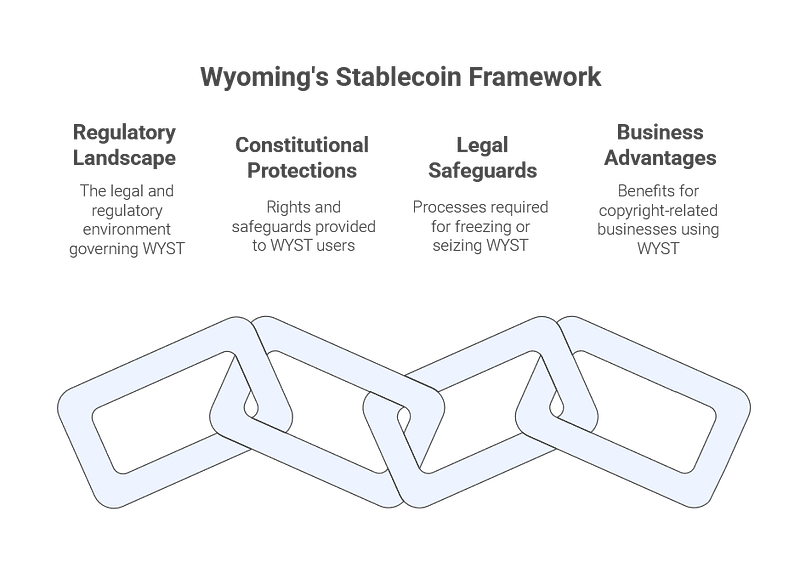
Wyoming’s approach to state-issued stablecoins differs fundamentally from central bank digital currencies in several important ways. While central banks issue Central Bank Digital Currency (CBDCs) and carry legal tender status, WYST is issued by a state agency and operates more like a private stablecoin with governmental backing.
This distinction is crucial for understanding the regulatory landscape and potential applications.

The constitutional protections that Wyoming provides for WYST users create significant advantages for copyright-related businesses. The state has explicitly acknowledged that, as a public entity, it is bound by constitutional constraints that include First Amendment free speech rights, Second Amendment protections for legal commerce, and Fourth Amendment protections against unreasonable search and seizure. Any freeze or seizure of WYST requires a proper legal process, including court orders or warrants, providing business operators with predictable legal safeguards that CBDCs cannot guarantee.
NIM and CaaS platform capabilities transform copyright management.
New Internet Media’s Copyrighted-as-a-Service platform addresses the substantial challenges facing content creators in managing intellectual property rights and receiving fair compensation for their work. The CaaS platform utilizes blockchain technology to create immutable records of content ownership and automate royalty payments through smart contracts, ensuring that creators receive prompt payment when their content is used or licensed.
The platform’s blockchain-verified ownership system creates tamper-proof records of copyright registration, serving as indisputable proof of provenance. When creative works are registered on NIM’s blockchain (the CopyrightChains infrastructure), they receive unique identifiers (CopyrightIDs) that withstand legal scrutiny and provide powerful defenses against infringement claims. This verification system eliminates the ambiguity that often complicates traditional copyright enforcement, providing clear documentation for legal proceedings.
NIM’s AI-powered monitoring capabilities continuously track digital platforms to identify unauthorized, altered, or derivative uses of registered content. These systems achieve a high detection accuracy and automatically generate licensing agreements for unauthorized uses, converting infringement into revenue opportunities. The AI monitoring extends beyond simple content matching to include advanced content fingerprinting that can identify derivative works, altered versions, and unauthorized remixes.

The platform’s automated licensing and compliance systems execute complex agreements, calculate royalties based on usage data, and distribute payments to rights holders in near real-time. This automation eliminates manual processing delays and reduces administrative overhead, while ensuring consistent enforcement of licensing terms. Smart contracts operating within Wyoming’s legal framework can adjust to changing regulations across multiple jurisdictions while maintaining consistent enforcement standards.
NIM’s integration with Wyoming’s regulatory framework provides enhanced legal standing for copyright enforcement actions. The platform leverages the state’s Series LLC structure to create separate legal entities for individual copyright works, providing comprehensive asset protection and liability segregation. This structure enables sophisticated investment arrangements where different copyrighted works can have distinct licensing terms and revenue-sharing arrangements, while maintaining clear legal separation between different intellectual property assets.
Authenta Invest’s copyright asset classification strategy
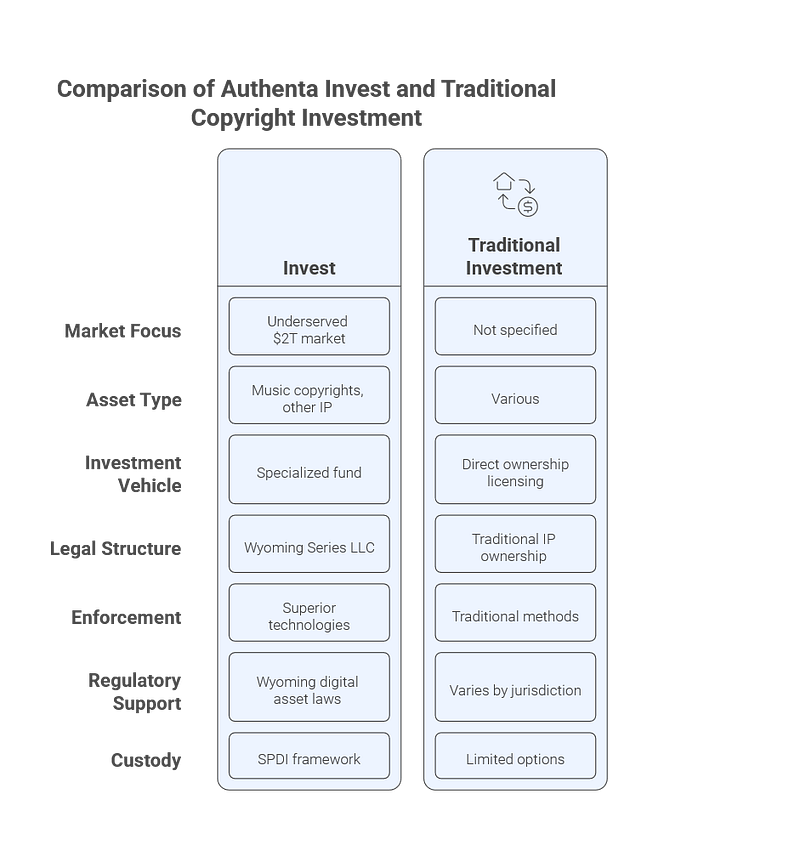
Authenta Invest represents an innovative approach to copyright investment, targeting what industry analysts estimate to be a $2 trillion underserved market. The fund’s focus on copyright royalty streams creates opportunities for both investors and creators by providing new sources of capital for intellectual property development while establishing copyrights as a recognized financial asset class.
The fund operates as a specialized investment vehicle focused on acquiring exclusive administration rights to music copyrights and other intellectual property assets. This approach enables institutional investors to participate in copyright markets through professionally managed investment vehicles that provide familiar corporate structures and clear legal protections. The availability of institutional-grade custody and compliance systems reduces barriers to large-scale investment in intellectual property markets.
Authenta Invest’s strategy leverages Wyoming’s Series LLC framework to create sophisticated investment arrangements where individual intellectual property assets can be held as separate legal entities within master organizations. This structure provides enhanced asset protection, liability segregation, and operational flexibility compared to traditional intellectual property ownership models. The combination of Series LLC structures with digital asset classification creates opportunities for fractional ownership, revenue-sharing agreements, and structured investment products that were previously difficult to implement.
The fund’s approach to copyright asset classification addresses the significant protection gap in creative industries, where traditional enforcement methods capture only 53 percent of available royalties. By deploying superior enforcement technologies and institutional backing, Authenta Invest can substantially reduce this gap while creating direct economic benefits for creators and rights holders. The enhanced protection creates new revenue opportunities from previously uncollected royalties, unauthorized uses, and derivative works.
Wyoming’s regulatory framework supports this transformation by providing clear legal definitions for digital assets and establishing custody standards that meet the requirements of institutions. The state’s Special Purpose Depository Institution framework enables financial institutions to safely custody digital assets representing copyright interests, addressing a key barrier to institutional adoption. This infrastructure provides rights holders with professional-grade asset protection and enforcement capabilities while enabling banks and other financial institutions to participate in copyright markets.
Technology infrastructure enables comprehensive transformation.
Wyoming’s multi-blockchain approach for WYST deployment creates opportunities for technical innovation that centralized systems cannot match. The state currently operates on test networks including Avalanche, Solana, Ethereum, Arbitrum, Base, Optimism, and Polygon. This blockchain-agnostic approach enables NIM and Authenta Invest to develop applications that leverage the most suitable technology for specific use cases while maintaining regulatory compliance.
The flexibility to operate across multiple blockchain networks allows for optimization based on transaction volume, speed requirements, and cost considerations. NIM’s platform can process high-volume micropayments for content usage, while Authenta Invest can execute complex smart contracts for investment products. This technical flexibility enables innovation while maintaining the stability and security necessary for institutional participation.
Zero-knowledge proof technology enables verification of ownership, licensing rights, and royalty entitlements without revealing sensitive investor identities or portfolio specifics. This technology allows rights holders to maintain complete confidentiality while benefiting from global protection and revenue optimization. The zero-knowledge approach enables anonymous monitoring and enforcement across jurisdictions with varying privacy requirements while maintaining regulatory compliance.
The automated compliance framework generates verifiable proofs while maintaining complete confidentiality, providing fully auditable trails for regulators and fund administrators without compromising privacy. Zero-knowledge proofs enable verifiable compliance with Know Your Customer, Anti-Money Laundering, and tax obligations across 140 jurisdictions, without requiring access to private data, thereby reducing compliance costs by over 90 percent compared to traditional models.
Smart contract governance through Wyoming’s DAO Supplement legislation enables algorithmic management of intellectual property assets while maintaining legal recognition and enforceability. This combination of legal recognition and technological automation creates opportunities for sophisticated licensing arrangements, royalty distributions, and investment structures that were previously impossible under traditional legal frameworks. The integration reduces administrative overhead while providing transparent and efficient management of complex intellectual property arrangements.
Market implications and competitive advantages
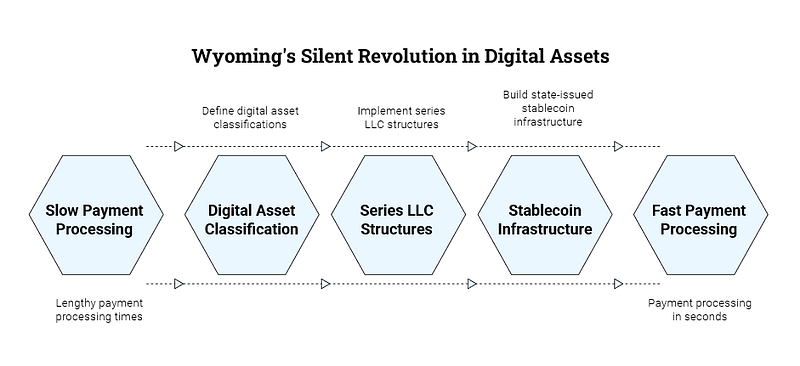
The recent pilot program conducted by Wyoming in partnership with blockchain startup Hashfire demonstrated the transformative potential of WYST for payment processing. The pilot successfully reduced vendor payment times from approximately 45 days to mere seconds, representing a 99.99995% improvement in processing speed. This dramatic enhancement addresses longstanding inefficiencies in payment systems while demonstrating how blockchain technology can substantially improve financial operations.
For copyright monetization platforms, this payment efficiency creates immediate competitive advantages. Content creators can receive royalty payments in real time rather than waiting weeks or months for traditional payment processing. The elimination of payment delays improves cash flow for creators while reducing administrative overhead for platforms and investment funds. This efficiency becomes particularly valuable for international copyright enforcement, where traditional payment systems often create additional delays and costs.
The comprehensive monitoring and automated enforcement capabilities enabled by Wyoming’s framework can increase royalty collection rates by more than 40 percent compared to conventional methods. This improvement in enforcement effectiveness creates direct economic benefits for creators and rights holders while reducing the estimated losses from copyright infringement. The enhanced revenue capture makes copyright investments more attractive to institutional investors while providing creators with better compensation for their work.

Wyoming’s constitutional protections for digital asset holders provide competitive advantages that CBDCs cannot match. The state’s commitment to respecting constitutional rights ensures that copyright-related businesses can operate without concerns about arbitrary government interference. This legal certainty enables long-term business planning and product development while providing confidence to institutional investors who require predictable regulatory environments.
The institutional backing provided by Wyoming’s framework creates enhanced legal standing for copyright enforcement actions. When copyright assets are held in institutional custody with proper documentation, enforcement actions carry significant legal weight and can be pursued more effectively across multiple jurisdictions. The established relationships that regulated institutions maintain with legal systems and regulatory authorities facilitate more efficient copyright enforcement actions while providing copyright holders with resources and expertise that individual creators typically cannot access.
The distinction between WYST and CBDC drives innovation.
To be clear. While CBDCs are issued by central banks and carry legal tender status, WYST is issued by a state agency and operates more like a private stablecoin with governmental backing. This distinction is crucial for understanding the regulatory landscape and potential applications in copyright monetization.
The structural differences create a more flexible and business-friendly environment for intellectual property applications. CBDCs typically come with extensive surveillance capabilities and direct government control over transactions, limiting their utility for commercial applications that require operational flexibility. WYST maintains the stability benefits of government backing while preserving the programmability and interoperability that enable sophisticated financial products for copyright monetization.
For NIM’s Copyrighted-as-a-Service platform, Wyoming’s approach offers substantial operational advantages. The state’s framework enables the creation of sophisticated financial products that leverage copyright royalty streams without the restrictive oversight typically associated with central bank digital currencies. This flexibility allows NIM to develop innovative monetization strategies for content creators while maintaining compliance with established financial regulations.
The technical architecture of WYST also differs significantly from proposed CBDC systems. Wyoming’s multi-blockchain approach enables deployment across various networks, providing flexibility for different applications and use cases. This blockchain-agnostic design enables copyright monetization platforms to optimize their operations according to specific technical requirements, rather than being constrained by a single, centralized system that characterizes CBDC frameworks.
Authenta Invest benefits significantly from Wyoming’s clear regulatory framework for digital assets compared to the uncertain regulatory environment surrounding CBDCs. The state’s comprehensive legislation provides the legal certainty necessary for developing investment products backed by copyright royalties. Unlike the uncertain regulatory environment surrounding CBDCs, Wyoming’s approach offers predictable rules that enable long-term business planning and product development for copyright investment vehicles.
The 102% overcollateralization requirement for WYST creates additional security for investment products compared to the variable backing that might characterize CBDC systems. When Authenta Invest structures copyright-backed securities, the underlying stability of WYST provides a reliable foundation for complex financial instruments. This stability is particularly valuable for institutional investors who require predictable returns and clear regulatory compliance frameworks.

Future impact on copyright and IP protection
Authenta Invest’s work to establish copyrights as a recognized financial asset class creates fundamental changes in how intellectual property generates value in the digital economy. The classification of copyrights as financial assets opens new capital markets for intellectual property investment while enabling traditional asset management firms to develop copyright-focused investment products. This institutional participation provides creators with new sources of capital while offering investors exposure to the growing digital content economy.
The transformation of copyright enforcement enabled by Wyoming’s digital asset classification represents a fundamental shift toward more efficient, effective, and economically sustainable protection of creative works. The integration of blockchain technology, artificial intelligence, and automated compliance systems enables more effective detection, enforcement, and monetization of intellectual property rights than traditional methods can provide.
Wyoming’s framework enables innovative business models that combine copyright enforcement with investment opportunities. Specialized funds can acquire administration rights to copyright portfolios while deploying superior enforcement technologies, creating new revenue streams for both creators and investors. The ability to tokenize and fractionalize copyright interests creates liquid markets for intellectual property investments while maintaining strong enforcement capabilities.
The enhanced enforcement capabilities create new revenue opportunities from previously uncollected royalties, unauthorized uses, and derivative works. This improved revenue capture makes copyright investments more attractive to institutional investors while providing creators with better compensation for their work. The comprehensive approach to enforcement can address infringement more comprehensively than individual efforts while leveraging economies of scale in legal and technological resources.
The global nature of copyright enforcement benefits from Wyoming’s standardized documentation and verification systems that are recognized across multiple jurisdictions. The use of blockchain technology for ownership records and licensing agreements creates transparent audit trails that facilitate international enforcement actions. The framework’s emphasis on compliance with international standards enables more effective coordination with foreign enforcement agencies and legal systems.
The success of Wyoming’s framework in attracting international businesses and investment demonstrates the competitive advantages of clear regulatory frameworks for digital assets. This success creates incentives for other jurisdictions to develop similar approaches while maintaining interoperability with Wyoming’s established systems. The state’s open-source approach to technology development enables other regions to adopt compatible systems while adapting to local legal and regulatory requirements.

Wyoming’s model transforms the creative economy.
Wyoming’s digital asset classification framework establishes fundamental precedents that will shape the development of intellectual property regulations for decades to come. The state’s comprehensive approach to integrating digital assets into established commercial law provides a stable foundation for intellectual property tokenization while maintaining appropriate regulatory oversight and consumer protection.
The success of Wyoming’s framework in attracting businesses and investment demonstrates the competitive advantages of clear regulatory approaches to emerging technologies. As other jurisdictions develop their frameworks for digital asset regulation, Wyoming’s experience provides valuable insights and established precedents that will influence the evolution of intellectual property law in the digital economy.
The combination of legal clarity, technical innovation, and constitutional protections that characterizes Wyoming’s approach creates a comprehensive model for balancing innovation with appropriate regulation. This model will likely serve as a template for other jurisdictions seeking to harness the benefits of blockchain technology for intellectual property applications while maintaining the legal certainty necessary for sustainable business development and investment.
NIM’s Copyrighted-as-a-Service platform, Authenta Invest’s copyright investment fund, and Wyoming’s state-issued stablecoin infrastructure demonstrate how regulatory clarity enables innovation while protecting the interests of stakeholders. These services create an integrated ecosystem that addresses fundamental challenges in copyright management while establishing new pathways for institutional investment in intellectual property assets.
The transformation of copyright from an underutilized creative asset into an institutional-grade investment vehicle represents a fundamental shift in how intellectual property generates value. This evolution benefits all stakeholders in the creative economy while establishing new standards for intellectual property protection and monetization in the digital age.
The implications extend beyond Wyoming’s borders, as the state’s approach demonstrates how thoughtful regulation can enable innovation while maintaining appropriate protections for users and investors. This model may serve as a blueprint for other jurisdictions seeking to support the growth of digital asset markets while preserving the constitutional principles that underpin free market economies and creative expression.
For stakeholders in the copyright and intellectual property sectors, Wyoming’s framework provides immediate opportunities to enhance protection, improve monetization, and access institutional capital markets. The state’s leadership in digital asset regulation positions it to drive continued innovation in copyright management while influencing the development of global standards for intellectual property tokenization and investment.


